Showing posts with label Chase. Show all posts

Friday, February 5, 2016

Short Sales are still selling in Sacramento, but they are a significantly smaller piece of the puzzle than before...

I met with a new buyer client last week, and during the course of our appointment, she asked me my thoughts about the possibility of  purchasing a short sale home. I explained that short sales, foreclosures, and "distressed properties" generally were far less prevalent in the Sacramento real estate market today than they were a few years ago.

Just the pure ratio of short sales to other types of listings in the market is low, so I suppose statistically buyers these days are less likely to purchase a short sale. Last quarter (November, December, January) there were 381 short sales in Sacramento County out of 5597 total homes for sale. That's less than 7% of all inventory.

This graph above portrays the market for short sale listings only in Sacramento County over the last 6 years. I remember there was a time about 5-6 years ago when ALL of my listings were short sales. All of them. 100% of them. That was a chaotic time in the market. An a chaotic time to be a short sale listing agent. I had many active listings, all of them short sales at varying stages of negotiation, and had to wake at 5am to start calling banks with loss mitigation departments on the east coast to negotiate payoffs. And most of my listings had both a first loan, and a second loan or home equity line of credit (HELOC), not to mention a few that had 3rd loans, or maybe IRS or FTB tax liens. Eh, I've done it all.

In 2015, only 20% of my listings were short sales. That is significantly fewer than 5-6 years ago, though proportionately more than double of the market in general. Considering I cultivated a deep skill set in negotiating short sales, it makes sense that while they are a tiny piece of the overall Sacramento real estate market right now, that I am still closing a fair number of them.

Tuesday, October 28, 2014

FHA Short Sales must now be marketed in MLS for a minimum of 15 days per new HUD guidelines...

Effective as of October 2014, some new Housing and Urban Development (HUD) guidelines per their Mortgagee Letter 14-15 now require agents to have a FHA short sale property listed on the Multiple Listing Service (aka, the MLS) for a minimum of 15 days before any purchase contract can be reviewed by the servicer.  This 15-day requirement starts when the property began listing on MLS at the appropriate price in relation to the Federal Housing Administration (FHA) "as-is" appraised value. Keep in mind FHA short sale sellers, this is NOT the date of the listing agreement, since usually listings are entered into MLS at a later time after the listing agreement is signed and dated. My guess is that this is in response to short sale properties not being marketed open and fairly to generate the highest and best offer for the short sale...

Wednesday, June 19, 2013

How to remove the monthly Mortgage Insurance payment, aka MI or PMI, from your home loan...

With Sacramento home values on the rise, several past clients have gotten in touch with me recently wanting to know three things: (a) how much is their home worth, (b) is it worth enough to remove my mortgage insurance, and (c) what is the process to do that?

First for those who don't already know, I should explain what Mortgage Insurance is. Mortgage Insurance, aka MI or PMI, is insurance that borrowers must pay for and is typically required for conventional mortgage loans when down payments or equity is below 20%, and ALL FHA loans. This insurance compensates lenders or "investors" for losses due to the default of a mortgage loan. The cost of mortgage insurance varies based on the amount of the initial downpayment for the loan, and how large the loan itself is.

So for example, if a buyer purchased a home with a conventional loan for $175,000, and made a 5% ($8,750) downpayment, the total loan would be approximately $166,250. At a 5% interest rate, the total monthly mortgage payment including loan principle, interest, property taxes, homeowner's insurance, and mortgage insurance would be approximately $1,235. About $109 of this payment would be mortgage insurance. Alternatively, if a buyer purchased a home for $400,000 and made a 10% ($40,000) downpayment, the total loan would be approximately $360,000. At a 5% interest rate, the total monthly mortgage payment would be approximately $2,625, and about $159/month would be mortgage insurance.

Wouldn't it be nice to erase that mortgage insurance portion of the payment and save some money? Here are the requirements for requesting the cancellation of your mortgage insurance on your primary residence:
  • You must not have any "subordinate" loans. Basically you can not have a Home Equity Line of Credit (HELOC), 2nd mortgage, etc.
  • You must have a good payment history -- don't make late payments!
  • You must have been making payments on the loan for at least 2 (or more) years. Sorry...if you bought your house last year you have to wait...
  • Your loan balance is either 80% of your original sales price, or you can demonstrate that your home has increased in value so that you have 20% equity.
So basically -- If you bought your Sacramento home for $175,000 2+ years ago, and you currently owe about $161,000 (based on my scenario above, the original financed amount of $166,250 would have been paid down to that amount), you must be able to demonstrate that your home is worth more than $200,000. The lender will determine the value either by an AVM -- a Zillow-like automated valuation tool, or you can do a full appraisal. You must provide a written request for cancelling your mortgage insurance. Call your loan servicing company and ask them where to send this request. Some will allow you to do this by fax and others will require it to be mailed. Specific criteria may differ from lender to lender, and mortgage insurance company to mortgage insurance company, so do your homework.

Given the current upward thrust of the Sacramento real estate market, many folks who financed a Sacramento area home 2 years ago will be able to make a strong case to their loan servicer that this monthly mortgage insurance be cancelled.

Another thing to note is that per the Homeowners Protection Act of 1998 (HPA), which covers single-family primary residences whose sales were closed on or after July 29, 1999 -- a borrower can request cancellation of mortgage insurance on the date the mortgage loan balance is first scheduled to reach 80% of original value, based solely on the initial amortization schedule of your loan (how it's paid down with your monthly payments), regardless of the outstanding balance of the loan. Again, you must request this of your loan servicer in writing and meet other criteria -- like timely payments.

If I can provide you with an estimate of your home's value to help you determine this, please send me an email to erin@erinstumpf.com and I am happy to provide you the data and a letter template to make your request to the loan servicer. If you have read my blog posts about tools like Zillow, you will know that I believe they are completely inaccurate (and for Sacramento homes, mainly just too low right now!).

Unfortunately, if you purchased with an FHA loan, you have a much longer wait (anywhere from 5 years, to when you pay off your loan, depending on when you made your purchase) to remove your mortgage insurance. Depending on your circumstances, if you have adequate equity and a good payment history -- it might just make sense to refinance your loan. One of my past FHA buyer clients is refinancing, transitioning from a 30-year FHA loan to a 15-year Conventional loan. He is lowering his interest rate, and getting rid of the MI, and his monthly payment is staying about the same! So basically he will own his home in half the time. Amazing...

Wednesday, February 27, 2013

How I use Twitter to get my Sacramento short sale listings approved...

Let's just say when I negotiate short sales, I don't like to sit back on the fence and wait for things to happen. If you follow me on Twitter (@erinnstumpf) you may already know that I was not getting the response I wanted from a short sale lender (who shall remain nameless) for one of my own Sacramento listings this week...I know this is a Freddie Mac loan thanks to information I obtained from both the lender and the Freddie Mac loan look-up tool. So rather than wait, I thought I'd try to engage Freddie Mac directly to escalate this short sale file.

How would I do that, you ask? Freddie Mac is the 800-lb gorilla government sponsored enterprise that owns (aka, is the investor for) a large percentage of the loans serviced by the big lenders (your Bank of America, GMAC, CitiMortgage, Wells Fargo, Chase, etc). I tweeted them!

Twitter is an outstanding tool to get a company, or in this case, a GSE's attention. As you can see from this screen shot, Freddie Mac is all over it this morning. Twitter is just one tool in a large arsenal I have to help my short sales happen. Most real estate agents aren't connected to Twitter, and many who are don't think to use it this way. I know my clients appreciate my creative maneuvering to get their short sale transactions closed.

Tuesday, February 12, 2013

Got an issue with a Fannie Mae Short Sale? Escalate the issue here...

Fannie Mae announced a new "HomePath for Short Sales" tool to help agents resolve short sale issues in a faster, more efficient manner.  This website provides a platform for a short sale "escalation" process and is available to any real estate professional working on a short sale involving a Fannie Mae-owned loan.

Fannie Mae "owns" or "is the investor" on many of the loans serviced by the big banks (and some smaller ones) like Bank of America, Wells Fargo, Chase, GMAC, CitiMortgage, Nationstar, etc. Often times, a while a loan servicer drives much of the short sale process, it is Fannie Mae that gets the final decision regarding the approval of a short sale. Click here to find out if your loan is owned by Fannie Mae.

So basically if you are having a challenge with a Fannie Mae short sale -- for example, the loan servicer isn't being responsive with a approval or rejection decision, a valuation was ordered but not completed in a timely manner, or the value of the property for sale was appraised higher than the market value, or a subordinate lien holder (2nd mortgage, home equity line of credit, etc) isn't cooperating -- open an inquiry with them and Fannie Mae will directly engage with the agent or loan servicer to address the issues. Keep in mind that you will need to be armed with SPECIFIC and detailed information regarding the transaction and the issue you are experiencing.

Agents can also use the new escalation process to receive a recommended list price from Fannie Mae prior to listing the property for sale, which is also awesome!

If you have your home listed for a short sale, the loan is owned by Fannie Mae (you can look that up here), and are experiencing issues -- encourage your agent to escalate the issue immediately. OR if you have a Sacramento home with a Fannie Mae-owned mortgage, be sure to list the home with an agent who is familiar with these escalation processes. If you are thinking about doing a short sale, of course I welcome your call to see if we are a fit to work together.

Thursday, January 3, 2013

Sacramento Short Sale Sellers: Cancellation of Debt Forgiveness has been EXTENDED another year!

Well, ding dong, hallelujah, oh yeah, yahoo, and boom! Not only does it seem that the United States won't tumble over the "Fiscal Cliff", but federal lawmakers have extended some very important provisions for Sacramento homeowners through the end of 2013.

I'll start with what I think is the most important one first -- this affects short sale sellers.

A few weeks ago, I was quoted in a Sacramento Business Journal article about the the need for an extension of the Cancellation of Debt Forgiveness for short sales. The existing legislation was in place through January 1, 2013 (yesterday). This provision basically cancels the income tax on the "forgiven" debt in a short sale. So over-simplified -- if you owe $300,000 on your home, and short sale it for $200,000 - you have been "forgiven" $100,000 in debt. The IRS traditionally views this sort of forgiven debt as income, and as such the homeowner would have to pay income tax on this $100,000. Thankfully, the US House of Representatives and the Senate extended this another year until January 1, 2014. Short sale sellers -- you still need to speak to your trusted tax professional to make sure you are protected by this legislation. While it applies to most homeowners, it does not apply to everyone! For example, one of the provisions is that the property must be owner-occupied primary residence in order to qualify for cancellation of debt forgiveness. Again, talk to your CPA.

All in all though, this is a huge break for Sacramento short sale sellers. I have short sale listings that did not close in 2012...so those sellers were anxiously awaiting for this to be extended. I also have been speaking with many potential short sale sellers who were waiting to list their homes until they knew if the cancellation of debt forgiveness would be extended. If you have questions about listing your home as a short sale in the Sacramento area, I am happy to answer your questions and speak with you in more detail. Feel free to call (916-342-1372) or email me.

The other items that were extended via the "Fiscal Cliff" legislation -- mortgage insurance premiums are still tax deductible for taxpayers making under $110,000. This was retroactivated for 2012 and extended through 2013. Also, a 10% tax credit (up to $500) for homeowners for energy improvements to existing homes is extended through 2013 and made retroactive to cover 2012.

So good things for 2012 and 2013...it's going to be a great year!

Thursday, November 8, 2012

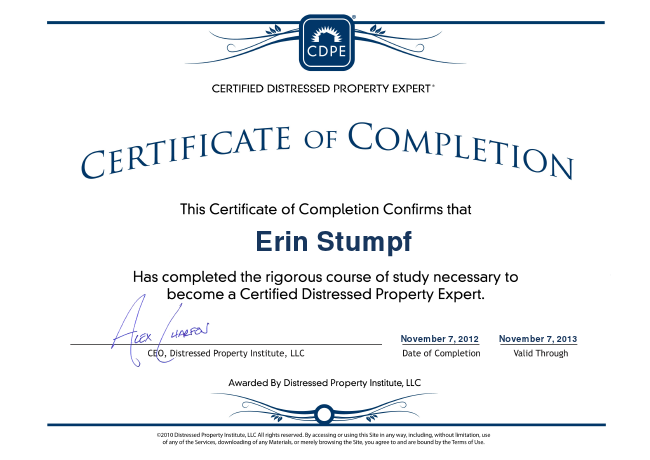
So I am a Certified Distressed Property Expert (CDPE)...I'm sure you can sense my enthusiasm...

Well, for the last couple of days this week, I have been in a classroom earning my "Certified Distressed Property Expert" designation, aka the CDPE. Between my own listings and those that I have negotiated on behalf of other agents, I have closed somewhere near 75 short sale listings....So while I can't say I really learned anything new that I haven't experienced first hand in one of my transactions -- this is definitely a solid course that can provide agents with a basic understanding of some of the fundamentals of doing short sales. This class is no substitute for experience though...so if you are thinking about doing a short sale on your own property, be sure that you ask your agent for client references and find out just how much experience they have in addition to that fancy CDPE designation that cost $450 (plus the upgrade to become an "advanced member" of the CDPE family for only $149 down and $99/month).

Many short sale lenders (like Chase, Wells Fargo, Bank of America, GMAC, CitiMortgage, etc) are now referring their distressed borrowers/sellers only to agents who have this CDPE designation, so I finally pulled the trigger and took the classes. Candidly, I was a little annoyed that after all my experience and depth of knowledge in Sacramento short sales I was forced into taking this course in order to justify to banks that I am competent to do these transactions. So anyway, now I am a CDPE for a year, until I cough up much more money to extend it another year. Extortion if you ask me. But whatever. I guess I just bought some additional credibility. And it's a good tax deduction at the end of the year.


Wednesday, October 31, 2012

Ask Erin: What happens to my short sale if my loan servicing is transferred to another company??

I listed a short sale in Orangevale a few weeks ago...at the time I listed the house, the loan was serviced with Bank of America and the sellers and I were navigating our way through their "Co-Operative" short sale listing process (where we complete a few steps in advance in order to list the property with a pre-approved short sale price). Then something happened...we were notified of an upcoming "Service Transfer" and the loan would be moved from Bank of America to another lender for servicing. Huh?

This does happen from time to time. Bank of America, like many other large lending institutions, services mortgage loans for hundreds of investors. An "investor" could be Fannie Mae, Freddie Mac, a hedge fund, another bank, etc. As a part of normal loan servicing, these investors may opt to release or transfer servicing from one company to another company.  In most cases, once the servicing transfer occurs, the short sale process ends with Bank of America and the homeowner must contact the new servicer to start navigating that company's short sale process.

When I list short sale property, I generally talk about the possibility of this happening with the seller. This is not a really common occurrence mid-transaction (this has happened only 4 times out of all of the 100+ short sales I have worked on), but a servicing transfer is a risk that may occur at any time during the short sale process -- EVEN after a short sale has been approved! This is one of the reasons why it is important to move as quickly as possible to facilitate a short sale.

Generally, if your loan is going to be transferred from one servicer to another, the current servicer will send the homeowner a letter 15 days before the servicing transfer date. The lender may or may not contact the listing agent -- so short sale sellers PLEASE open your mail and keep your agent in the loop as far as what the communications say! The new loan servicer will send a introduction letter to the seller with a new loan number and payment or collection info. One thing to note -- before you send ANY payment or personal information to the new servicer, please call them to verify that your service has been transferred and the new mailing address. Some fraudsters will send bogus letters in an attempt to get you to mail them money or steal your identity! If an offer has already been accepted on your short sale, a closing has been set and an approval letter issued, the new servicer will determine if the short sale will continue. Unfortunately the new servicer may not be obligated to honor the approval.

Thursday, October 4, 2012

Sacramento Real Estate Listing Inventory September 2012

Where have all the Sacramento home listings gone? Well , there are not as many homes on the market in MLS. AND the homes that are listed are selling quickly. Our absorption rate in Sacramento is amazing - we have less than one month's worth of housing inventory on the market. In fact, we have nine tenths (0.9) of a month of for sale housing inventory here in Sacramento County. I am seeing multiple offers on my listings, and it's really competitive out there. I have six theories as to why there are not too many homes on the market right now. When I wrote my "Six Theories" post in May of this year, interest rates were higher then than they are today -- they were around 4% vs. 3.25% today for a 30-year fixed loan -- and our median home price in Sacramento has increased from $167,000 in May to $180,000 last month in September. Statistics don't lie...the market is HOT! I think most home buyers have decided now is the time to buy...and with prices increasing, perhaps folks who need to sell will decide now is the time to sell...

Wednesday, August 1, 2012

It's August 1st...Have you started your short sale yet? Time in 2012 is running out...

No, I am not referring to the 146 shopping days left until Christmas. I am referring to the time left (152 days) in 2012 that short sale sellers can still take advantage of some of the state and federal debt forgiveness tax laws. Many short sale sellers who occupy their home as a primary residence and meet other criteria will have little or no tax consequence from completing a short sale in 2012. Many short sale sellers have benefited from legislation in place protecting them that will expire December 31, 2012. The difference in closing a short sale in December 2012 and January 2013 could cost a distressed homeowner several thousand dollars in taxes. I am not a CPA and refer my clients to tax professionals to seek advice in this regard to make sure these laws apply to their situation.

In a nutshell (and completely over-simplified), if a homeowner does a short sale and owes $300,000, and the NET proceeds from the sale that a bank will accept in a short sale equal $200,000, the seller of the property receives a 1099 from the bank for $100,000 (the amount of the "forgiven" debt). You will get this 1099 regardless of when you close your short sale, BUT for short sales closed in 2012, many sellers will not have to pay income tax on this "forgiven debt." If you close in 2013, if the current legislation in place remains un-extended to a later expiration date, you could have a very large tax bill to pay when you file your taxes the following year. Again, speak to a CPA regarding how this affects your situation. If you need a referral to one, contact me and I am happy to give you one.

Given the length of time that short sales take, if you want to complete a short sale in 2012 you need to start the process NOW.  Think I'm exaggerating? Assuming a seller doesn't have some odd circumstances, the lifespan of a typical Sacramento short sale looks something like this:

-Listing the property, preparing for showings, gathering financial and hardship info to submit to short sale lender: 7-14 days. My vast short sale experience tells me that most folks can't (or won't want to) list the house tomorrow and start showing it by this weekend. If your average seller called an agent today, met with that agent tomorrow, then spent time gathering their financial info and making the house presentable making arrangements for pets, extra house keys, etc., the house would realistically hit the market within 2 weeks.

-First on market day, showings, and seller accepted offer to submit to lender: 7-10 days. Let's face it, if a property is priced correctly and the seller is flexible with access to the house for showings, given the current lack of homes on the market, this process should be relatively quick.

-Lender receives all financial and hardship information from the seller, purchase contract and supporting documentation, assigns a negotiator and orders BPO valuation of the property: 7 - 14 days. Some short sale lenders are faster than others. Most of the larger banks (Chase, Wells Fargo, BofA, GMAC, CitiMortgage, HSBC, etc) have pretty streamlined processes for getting the files assigned to folks and the initial BPO values established.

-BPO agent/appraiser visits property and returns value analysis report to short sale lender: 7-14 days. For the sake of defining it, a BPO essentially an appraisal ordered by the short sale lender. This is their method to best validate the buyer's offer received and determine the fair market value of a property. The folks who do these BPO's are unaffiliated 3rd parties who might have 20 other BPO's to do at the same time. Once the assignment is received, it might take them a few days to fit visiting the property into their schedule (longer if the house is occupied and they must coordinate access to the house with someone else), then visit the property, then complete the report and submit back to the short sale lender that ordered the BPO.

-BPO received by negotiator, analysis of file: 7 - 45 days. Yikes. This can take a long time...the file could be re-assigned to a new negotiator and it could go to the bottom of that person's stack.

-Submitted to investor or management for final approval: 3 - 30 days. Again yikes. Depending on who actually controls the decision-making process of the loan, this could be super fast, or painfully slow. Best case scenario is that the loan is owned by the short sale lender itself and it's just making a management decision if the short sale fits within its internal guidelines, OR, perhaps Fannie Mae or Freddie Mac must approve the short sale. Or perhaps the loan is owned by a Hedge Fund, or a Retirement Fund. If it turns out that the Missouri State Teacher's Retirement Fund owns the loan for example (not to pick on them, if they even exist LOL), and Margie in Accounting is the ultimate decision-maker, you might be in for a longer wait.

So then approval issued! Yay! Now what...well depending on the offer you received from your buyer, you will be looking at 21-45 days to close your escrow, barring no additional surprises with the buyer's loan or inspections, of course.

So on the fast end of the normal timeline spectrum from the day the house hits the market to the day the short sale is approved -- you are looking at about a month if all the stars align, plus the time it takes for the buyer to close escrow. If you are this fortunate and have a very straight-forward short sale and no surprises, congratulations you still have plenty of time to complete your short sale before the end of 2012.

On the longer side of the normal timeline spectrum from the day the house hits the market to the day the short sale is approved -- you are looking at 3-4 months, plus the time it takes for the buyer to close escrow. This timeline is more realistic for most short sales, AND it will push you to the very end of 2012. It'll be stressful, but you have time to get your short sale closed.

So...if you need to do a short sale and can benefit from the tax laws that will expire at the end of 2012 - what are you waiting for? I welcome your call if you have questions I can answer or to see if we are a fit to work together.

Monday, June 11, 2012

Short sale and appraisal crisis averted...but it put a crimp in my afternoon schedule...

I visited a short sale condo in Natomas today that I have in contract with a buyer client...it should have been a 5-minute visit to the property to let myself in, to install a carbon monoxide detector before tomorrow's appraisal, and then leave. But those plans were thwarted by Safeguard Properties. It's not really their fault...they are just doing their jobs.

Ever heard of them? No? They are a "property preservation" company. They work on behalf of many loan servicers (like CitiMortgage, GMAC, Chase, Bank of America, Wells Fargo, etc), and they employ field reps that monitor properties in default or with past due balances. Why, you may ask? Their sole job is to make sure that the bank's "assets" (aka, properties their loans are on) are in decent condition, being properly maintained by their occupants, and that they are properly secured. If that field rep determines that a property is vacant, not secure, or not being properly maintained, those reps post notice on the house (usually on the front door or front window) requiring that the occupant or "responsible person" contact them via a toll free number immediately -- usually within 2-3 days. Occasionally the listing agent or homeowner will receive a follow-up call once this notice is posted, but not always. If nobody contacts the field rep, then many times that person, who is acting on behalf of the loan servicer, will take it upon him/herself to make sure the physical integrity of the "asset" is not compromised. What does this mean?? Usually it means they change the locks and take whatever measures they believe to be appropriate to secure the house (like board up windows, lock side gates, etc). I blogged about this a couple years ago.

I always give my short sale sellers a heads up that monitoring from a property preservation company like this is a possibility, and that they really need to make the effort to maintain their property if they are not living there, keep it secure, and monitor the house for notices of this nature.

This listing agent did not prep her seller. So, when I arrived to open this unit to install a carbon monoxide detector, the key in the MLS lockbox did not open the lock, and there was another combo lockbox on the front door. I ended up waiting around for more than an hour while the listing agent called the field services rep to get the combination to the new lockbox on the house. Once she was able to give me the combination to this new lockbox, I entered and installed the carbon monoxide detector, and I then had a look around. I noticed that none of the lights worked and the toilets were empty. I found the electrical panel and all of the breakers were in the "off position." I turned them on. I also turned on the water to the toilets and made sure they flushed properly.

Thankfully I visited the house today, BEFORE the appraiser was scheduled to come out tomorrow...most likely he would not have waited around for an hour while the listing agent obtained the combination to the new lockbox, and may have charged an additional fee to my buyer client to re-visit the house at a later date. If the appraiser had indeed waited around, then the utilities would not have been operable for his inspection, which would have also required him to make another visit to the property. Either of these scenarios would have cost my buyer money and the timeframes in the transaction may have been delayed.

So after nearly 90 minutes at the house, I put a copy of the new key in the MLS lockbox for the appraiser to use tomorrow to access the unit, made sure the utilities on and light and plumbing fixtures functioned properly, oh yeah, and I installed that carbon monoxide detector -- a potential crisis was averted...

Monday, March 5, 2012

Doing a short sale with Chase? Here is what you need to gather...

Well...it's not a secret that I do A LOT of short sale transactions in the Sacramento area...and many of them lately have been with Chase. I like Chase's short sale process. It's pretty predictable and their loss mitigation negotiators seem to be on top of their game and different short sale programs. So if you are looking to do a short sale on your Sacramento-area home and have a mortgage with Chase, here is a list of the documentation you need to gather as you get ready to list your home with a Realtor;

-Last 2 paystubs or other proof of income
-Most recent bank statement
-If self-employed, your profit and loss statement
-If self-employed, last 4 months of bank statements
-Most recent tax return
-A recent utility bill in your name showing the property address
-Rental Lease Agreement if the property is occupied by tenants
-Chase Request for Consideration of Short Sale Form
-3rd party authorization letter (allows your Realtor to speak to Chase on your behalf)
-Hardship Letter
-IRS 4506-T

I welcome your call if you have any questions regarding a Chase short sale.

Thursday, March 1, 2012

Sacramento Help for Homeowners Events - Coming March 20th, 2012

Sacramento homeowners who are struggling to make their mortgage payments will have the opportunity to meet face-to-face with their mortgage companies, as well as HUD-approved housing counselors, in an effort to assist explore foreclosure-prevention options and to move toward solutions to their mortgage problems.

Help for Homeowners Community Event
Tuesday, March 20, 2012 from 1:00pm – 8:00pm
Sacramento Convention Center
1400 J Street, Hall D
Sacramento, CA 95814

Free parking is available in the Memorial Garage (entrance on 14th and H Streets). It is highly recommended that you bring with you:
Link
-Request for Mortgage Assistance form
-IRS Form 4506T and/or last two years of tax returns
-Monthly mortgage statement
-Information about other mortgages on your home, if applicable
-Two most recent pay stubs for all household members contributing toward mortgage payment
-Unemployment benefits award letter, if applicable
-If self-employed, the most recent quarterly or year-to-date Profit and Loss Statement
-Documentation of income you receive from sources (alimony, child support, social security, etc.)
-Two most recent bank statements
-A utility bill showing homeowner name and property address

Sacramento Short Sale Information

Monday, October 31, 2011

Got an FHA Loan? Want to do a short sale on your Sacramento home? Here are the steps...

I have been doing a bunch of FHA short sales lately, and I have to say I enjoy doing them. No, I'm not crazy! It just so happens that the US Department of Housing and Urban Development (HUD), the federal agency that handles the FHA programs, has created a short sale process that loan servicers are required to follow...

Loan servicers (think Bank of America, Wells Fargo, Chase, GMAC, etc) must follow the steps of the HUD "Pre-Foreclosure Sale" process. That's right -- they MUST. Which is really nice for me...as a real estate agent that does A LOT of short sales, predictability in what is generally a pretty unpredictable process is a luxury.

A few general criteria if you have an FHA loan on your Sacramento area home and are contemplating selling via a short sale;
  • FHA usually requires that the home be owner-occupied. If you must move out of your home because of a hardship that requires you to relocate, such as a job transfer, divorce, to care for a sick relative, etc, there are some exceptions.
  • Theoretically, the seller must be at least 31 days delinquent on the loan. Let me clarify that in order to negotiate the short sale, the borrower can be totally current with the monthly mortgage payments. It is when escrow closes on the sale that you must have missed one payment...and (shh!), I have gotten an FHA short sale completed where the seller wasn't technically 31 days late.
  • There is a FHA Pre-Foreclosure Sale application that must be completed and filled out. The borrower will need to know the FHA "case number" for the property. This can be found on the original loan documents. If those aren't handy, you can call FHA's help line at 800-225-5342 and find out.
  • You will also need to collect your bank statements, paystubs, write a hardship letter, write an explanation regarding the occupancy status, and if utilities are on and being paid, etc.
  • FHA conducts a full-blown appraisal of the house to determine value.
  • Once all of the document and appraisal conditions have been satisfied and hardship determined, FHA issues a form 90045 -- Approval to Participate in the Pre-Foreclosure Sale.
  • FHA Form 90045 will disclose the appraised value. The NET proceeds to the loan servicer generally must be greater than 88% of this value, taking into account paying all of the costs associated with the sale, including real estate agent commissions, title insurance, escrow fees, transfer taxes, etc.
  • Often times, with a timely close of escrow, the seller can receive a "relocation incentive" of up to $1,000 at the close of escrow, paid from the sales proceeds of the house.
The seller MUST be approved by FHA for the pre-foreclosure sale program before the loan servicer can review or approve any offers...so keep that in mind. Approval timeframes after receipt of the 90045 vary per the loan servicer, but I'd estimate 1-3 weeks.

Also if you are a buyer of an FHA short sale property, FHA does not approve any seller credits to the buyer of an FHA short sale UNLESS the buyer is obtaining a new FHA loan -- and in those cases the credit for closing costs is limited to 1% of the purchase price. Also, the property is sold as-is, and the FHA will not cover the cost of any buyer home warranty. So buyers, prepare yourselves for that reality.

So...if you are contemplating doing a short sale on your Sacramento area home and have an FHA loan, be sure to select a real estate agent that is intimately familiar with all of the steps of the process. I would be happy to explain the process in more detail for you and assist you with your transaction. Of course I am happy to do the same for any non-FHA short sale you want to do as well.

Monday, July 18, 2011

SB 458 Passes: NO Short Sale Deficiency Judgements on Second Trust Deeds (aka, Junior Liens) in California!

I have not noticed much media coverage for this, but on Friday, California Governor Jerry Brown on signed SB 458 (Corbett) into law. SB 458 extends the protections of SB 931 (passed and signed into law last year by Governor Schwarzenegger) to also include junior liens, aka 2nd mortgages. Both pieces of legislation state that a lender that agrees to a short sale must accept the agreed upon short sale payment as payment in full of the outstanding balance of all loans.

Prior to SB 931 and SB 458, only financing obtained at the time a home was purchased contained "anti-deficiency" protection -- meaning the mortgage lender could not pursue any action or have recourse to recoup their loss or "deficient" balance. Now these protections are extended to refinanced loans, and "junior" liens.

A short sale is a transaction in which the homeowner owes more on the loan than the property is worth. In order to sell the home, the mortgage holder(s) must approve the sale because the amount owed is "short" of what is currently owed by the seller.

SB 458 contains an urgency clause making it effective upon signing (July 15, 2011)...so it now it would seem that any California short sale seller who closes their transaction successfully would have protection from recourse afterwards...good news for distressed property sellers!

I do many short sales in Sacramento, often times for sellers with multiple loans on their homes. This, combined with the state and federal "phantom income" tax relief, will certainly create a much more favorable environment for short sale sellers who already have financial hardships to get their properties sold -- one less thing to worry about.

This legislation was championed by the California Association of Realtors -- of which I sit on its Board of Directors. I have blogged before that we advocate on behalf of property owners since there is no "California Association of Home Owners." I am very pleased to see that we were successful in our efforts to help California (and specifically Sacramento-area) sellers who need to sell but are upside-down in the value of their homes.

Wednesday, April 27, 2011

Financing Sacramento Condos...it's the WILD WEST!


I have resisted the urges to write about my most recent adventure representing the buyer in the purchase of a condo until after the close of escrow...thankfully escrow finally closed on Tuesday. Tuesday was exactly 27 days after our originally scheduled 30-day close of escrow. Why? Financing issues. The good news is now the loan officer and I are basically specialists in this particular condo community -- Serenade at Regency Park at 50 Regency Park Circle in Sacramento / Natomas.

In previous posts, I have warned Sacramento condo buyers (and sellers, for that matter) that in many cases, it is EXTREMELY difficult to finance condos. In the instances of buyers seeking to use FHA or VA financing, the condo communities must be on a pre-approved list. The condos and their Homeowners Association (HOA) must meet certain criteria that is screened in advance. For conventional lending, Fannie Mae and Freddie Mac have approved lists too.

So just how do you finance a condo that is not on the FHA, VA, Fannie Mae, or Freddie Mac approved list??? That is the million dollar question!! The answer is that you must undergo the 'Exception Review' process...ARGH. This process allows the lender to ensure that the condo community meets their condo lending requirements -- for example, the HOA must have adequate insurance, there can not be a high percentage of non-owner occupied units (rental units), there can not be litigation involving the property, the HOA must have adequate cash in the bank, there can not be a high number of owners who are delinquent in payment of their HOA dues, and MANY other things.

In short, there are many condo communities that will not qualify for lending under the 'Review' process. Having said that, there are also many communities that will...but the process is so lengthy and labor intensive most loan officers are not willing to do it. Additionally, while Fannie Mae and Freddie Mac have certain requirements, individual lenders (GMAC, Wells Fargo, Chase, BofA, etc) also add their own requirements. Needless to say, the buyer and loan officer were willing to suffer through the process...the loan officer went through the process with multiple lenders, and finally found one willing to finance the condo. It literally took two months for this process. Thankfully we had a seller willing to wait out the process as well...if she had not been willing to wait for this financing, she would have had to find a cash buyer for the condo.

In the end it all worked out, but not without cooperation from all parties -- listing agent, buyer's agent (me), loan officer, buyer, seller, etc. The moral of the story, make sure everyone know what they are getting into...and if you are looking to purchase or sell a condo in Serenade at Regency Park in Natomas -- we do not have to reinvent the process if you work with me and/or the loan officer who handled this...contact me for details and I am happy to provide them.

Tuesday, March 1, 2011

Sacramento Short Sale Resources & Tools


Over the last couple weeks I have been compiling a Sacramento Short Sale Directory of sorts from my experiences dealing with the different loan servicers, loan investors, and short sale programs...so, if you are looking for information dealing with Sacramento Short Sales, there is now a section on my website aptly named "Short Sale Tools." Check it out! I have tried to make sure all the short sale information is relevant and up-to-date...hopefully you find it to be of value. I have negotiated short sales with MANY entities, and I will continue to modify and add to this directory over time. Cheers!

Friday, September 3, 2010

I am now a Certified HAFA (Home Affordable Foreclosure Alternatives) Short Sale Specialist!


On Monday of this week, I attended a day-long training at the Sacramento Association of Realtors to augment my existing knowledge of the HAFA (Home Affordable Foreclosure Alternatives) Short Sale Program. Overall, it was an informative course. Much of it was review of the history of HAFA, the procedural steps of the program, and a review of the timeframes and paperwork involved. So, I took the tests today, and I am officially a "Certified HAFA Specialist." I have successfully closed so many short sales in our Sacramento-area real estate market, I feel like having this certification is a bit of a formality, but perhaps it will provide my short sale sellers an additional level of assurance that I actually know what I am doing (aside from my numerous short sale seller client references, good track record, the mentoring I have given other agents, etc)!

Friday, April 2, 2010

I was Quoted in a Sacramento Bee Article about Short Sales

I spoke to Jim Wasserman of the Sacramento Bee briefly on Wednesday regarding the new Federal HAFA (Home Affordable Foreclosure Alternatives) Program that takes affect on Monday, April 5th. He used a few of my quotes for an article that appeared in today's SacBee about Short Sales.

The premise of the HAFA Program is good idea and all (to streamline the short sale process and provide financial incentives to lenders and sellers/borrowers for doing short sales)...and like the HAMP Program for loan modifications, I think that the implementation by the loan servicer participants, and overall effectiveness of HAFA will be slow and probably a bit clumbsy to gain any real momentum. I do not think the financial incentives offered to these servicers will be any major carrot for compliance with the program...

Apparently, all the of the loan servicers that are (voluntarily) participating in HAMP will be required to (voluntarily) participate in HAFA as well. There are many loan servicers that are working with the HAMP Program already - many of the major ones include Aurora Loan Services, American Home Mortgage Servicing, Bank of America (formerly Countrywide), JP Morgan Chase, CitiMortgage, GMAC, HomEq, Litton Loan Servicing, National City Bank (aka, PNC), OneWest Bank (formerly Indymac), US Bank, Wachovia, and Wells Fargo...there are several other small banks and credit unions on board.

I have spoken to many of the loss mitigation reps at all of the loan servicers I am doing short sales with (literally, reps from that entire list above), and most have never even heard of HAFA. Wells Fargo's loss mitigation department seems to aware of HAFA though, and seems to be restructuring itself a bit to get ready...but again, I think the roll-out will take a long while....and as I am quoted in the SacBee article, Wachovia has the smoothest short sale process out there already. Time will tell!