Showing posts with label Tenants. Show all posts

Monday, September 14, 2026

Can a New Duplex Owner Terminate Month-to-Month Tenants in the City of Sacramento?

I recently spoke with an aspiring real estate investor who was considering purchasing a duplex in Midtown Sacramento. Both units were occupied by long-term tenants (long term = occupied the unit for more than one year) on month-to-month rental agreements. His plan sounded pretty straightforward: purchase the property, give the existing tenants notice, furnish the units and operate them as short-term rentals. Interesting idea. But there was an important wrinkle: Just because a tenant is month-to-month doesn't necessarily mean a new owner can simply give them notice and ask them to leave.

Buying the property doesn't eliminate or void the existing tenancy. And this is an especially important consideration when purchasing an occupied multi-family duplex, triplex or fourplex within the City of Sacramento due to their Tenant Protection Program. 

Buyers naturally spend a lot of time analyzing the real estate itself. What is the condition of the roof? How old is the HVAC? What are the operating expenses? Does the property need updating? But with an occupied investment property, the tenants and their tenure in the unit are every bit as important. I sometimes put it this way: you're not just buying the building. You're also buying the existing tenancies. And those tenancies can directly affect what you're able to do with the property after closing. 

But what if the tenants are month-to-month? This is where investors can get tripped up. It's easy to hear "month-to-month" and assume that means the tenancy can simply be terminated with appropriate notice. But rental units covered by the City of Sacramento's Tenant Protection Program can have just-cause eviction protections once a tenant has occupied the property for more than 12 months. In other words, the expiration of an original lease and conversion to a month-to-month rental agreement doesn't necessarily eliminate the tenant's protections. 

A landlord generally needs a legally recognized "just cause" to terminate a protected tenancy. Some qualifying "just cause" reasons involve actions by the tenant, such as failure to pay rent, certain breaches of the rental agreement, nuisance or criminal activity, or failure to provide lawful access. 

There are also certain circumstances that don't necessarily involve wrongdoing by the tenant. These are sometimes referred to as "no fault evictions" and can include an owner move-in, withdrawal of the unit from the rental market, or necessary and substantial repairs requiring temporary vacancy. But simply purchasing a property and preferring to have it vacant is not, by itself, the same thing as having a qualifying just cause. 

Why this matters to your investment strategy? Go back to the duplex this potential buyer was considering. His entire investment plan depended on terminating the existing tenancies and taking possession of both units after closing. That makes the status of those tenancies more than a minor due-diligence question. It's fundamental to whether his proposed investment strategy will work at all.

Maybe you want to buy a duplex and live in one side. Maybe you plan a significant renovation. Maybe you're buying a property for another family member to occupy. Or maybe, like this investor, your plans for the property are completely different from the current owner's use. Whatever the goal, if your plan requires an existing tenant to leave, you should understand whether you can legally accomplish that before you purchase the property.

This is also an area where I encourage clients to consult a qualified landlord-tenant attorney. As a Realtor, I can help identify the real estate issues we should investigate and obtain information about the existing tenancies, but determining whether a particular tenancy can legally be terminated is a legal question. 

And we're specifically talking about the City of Sacramento. Here's another detail that can easily cause confusion. The City of Sacramento's Tenant Protection Program applies within Sacramento city limits. That is a specific governmental jurisdiction. A property having "Sacramento, CA" in its mailing address does not necessarily mean it's located within the incorporated City of Sacramento. There are large areas around Sacramento that people commonly refer to as Sacramento, and that may even use Sacramento as their mailing city, that are actually located in unincorporated Sacramento County. That distinction matters because local ordinances can be different depending on which jurisdiction the property is actually located in. Some areas that are NOT in the city limits with a Sacramento mailing address include the Arden-Arcade area, Foothill Farms area, South Sacramento area, Rosemont area, most of the College Greens area, most of the Sierra Oaks area, etc.

So if you're considering purchasing an occupied rental property, don't make assumptions based solely on the mailing address or ZIP code. Verify the property's jurisdiction. And remember that properties outside Sacramento city limits may still be subject to California state landlord-tenant laws and other applicable protections. Being outside the City simply means that this particular City of Sacramento ordinance may not apply. 

But the moral of the story is to understand and be familiar with the basics before you buy. When evaluating an occupied multifamily property, I want to know more than the number of units and what the building looks like. How long has each tenant lived there? Are there written leases? Are they month-to-month? What documentation has the seller maintained? Are there agreements or notices that a buyer needs to know about? Is the property within Sacramento city limits? Is it subject to the City's Tenant Protection Program? Do other protections apply? And perhaps most importantly: Does your plan for the property depend on one or more of the existing tenants leaving? If the answer is yes, that's something to investigate early. There can be tremendous opportunities in Sacramento duplexes, triplexes and fourplexes. But with an occupied property, understanding exactly what you're buying means understanding both the real estate *and* the ramifications of the tenancies that come with it.

It is worth noting that this post is intended to provide general real estate information and is not legal or tax advice. California landlord-tenant law and local tenant protections are complex and can change. Buyers, sellers and property owners should consult a qualified landlord-tenant attorney regarding a particular property or tenancy.

Monday, September 23, 2024

Proposition 33: VOTE NO

Let me clear up misperceptions about Proposition 33: VOTE NO. It is a deeply flawed rent control initiative that will hurt both California's renters and housing providers. Despite some confusion I’ve seen and heard about what this measure would do, let me be crystal clear: Prop 33 would dismantle key protections under the 1995 Costa-Hawkins Rental Housing Act (passed by the California Legislature) and lead to harmful consequences for the housing market. 

Here’s why you should vote NO: 

(1) Prop 33 would cripple development of new rental properties: Prop 33 would allow rent control on properties built after 1995. Right now, Costa-Hawkins prevents rent control on newer buildings, so that developers continue to invest in creating rental housing. If Prop 33 passes, rent control could be imposed on all properties, even new construction. Why would any developer build in California if their units could be immediately subject to rent control? This will absolutely bring development of new rental properties to a screeching halt, worsening the housing crisis. How would this be good for anyone? 

(2) Prop 33 would eliminate fair rent adjustments after a tenant moves out: Under Prop 33, housing providers would no longer be able to raise rents to market rates after a tenant moves out. Currently, Costa Hawkins allows "vacancy decontrol" which permits rents to be reset to a market-rate when a tenant vacates a unit. This ensures housing providers can cover costs like renovating the unit, maintenance, and the rising costs of property taxes and insurance. Without this, providers will absolutely struggle to keep up with the increasing costs of maintaining their properties and keep up with inflation, leading to financial strain and fewer rental options as these housing providers decide to go out of business. How does that help tenants? 

(3) Prop 33 would hurt “mom and pop” property owners: Prop 33 would even allow rent control to be applied to single-family homes, which are currently protected under Costa-Hawkins. This move would further discourage single-family homeowners from renting out their properties, shrinking the already limited rental market and reducing housing options for families. I’ve personally talked to several rental homeowners who are fearful of Prop 33 passing and would sell these homes immediately - which would take these rental homes off the rental market. How’s that good for tenants? 

Prop 33 is literally a recipe for disaster. It will stifle new housing development, punish housing providers, and ultimately lead to fewer (not more) rental options for Californians. We are currently over 3 MILLION housing units short of what we need in California according to the California Department of Housing & Community Development. Let’s focus on fixing our severe housing shortage and on BUILDING MORE PLACES FOR PEOPLE TO LIVE. Please - vote NO on Prop 33.

Thursday, February 24, 2022

New listing - 5801-5803 Hazel Avenue, Orangevale, CA 95662

Excellent investment opportunity with this well-maintained Orangevale duplex! Convenient, high-demand location. Each unit is 2 bedrooms, 1 bathroom, attached 1-car garage, and are essentially mirror images of each other. Spacious units flow nicely with lots of living space, open floorplans, vaulted ceilings, laundry hook-ups, big bedrooms, updated kitchens, ample storage, newer fencing. Per assessor a HUGE 0.21ac lot with two private/fenced backyards and space to potentially explore opportunities for increased unit density. Both units have newer dual pane windows, central heat & air, and composition roof. Low maintenance landscape! Located near shopping, public transportation, parks, award-winning schools, and easy access to public transportation and Hwy-50. Income and expenses available upon request. Offered at $599,900. For more photos and information please visit 5801-5803 Hazel Avenue, Orangevale, CA 95662.

Friday, September 10, 2021

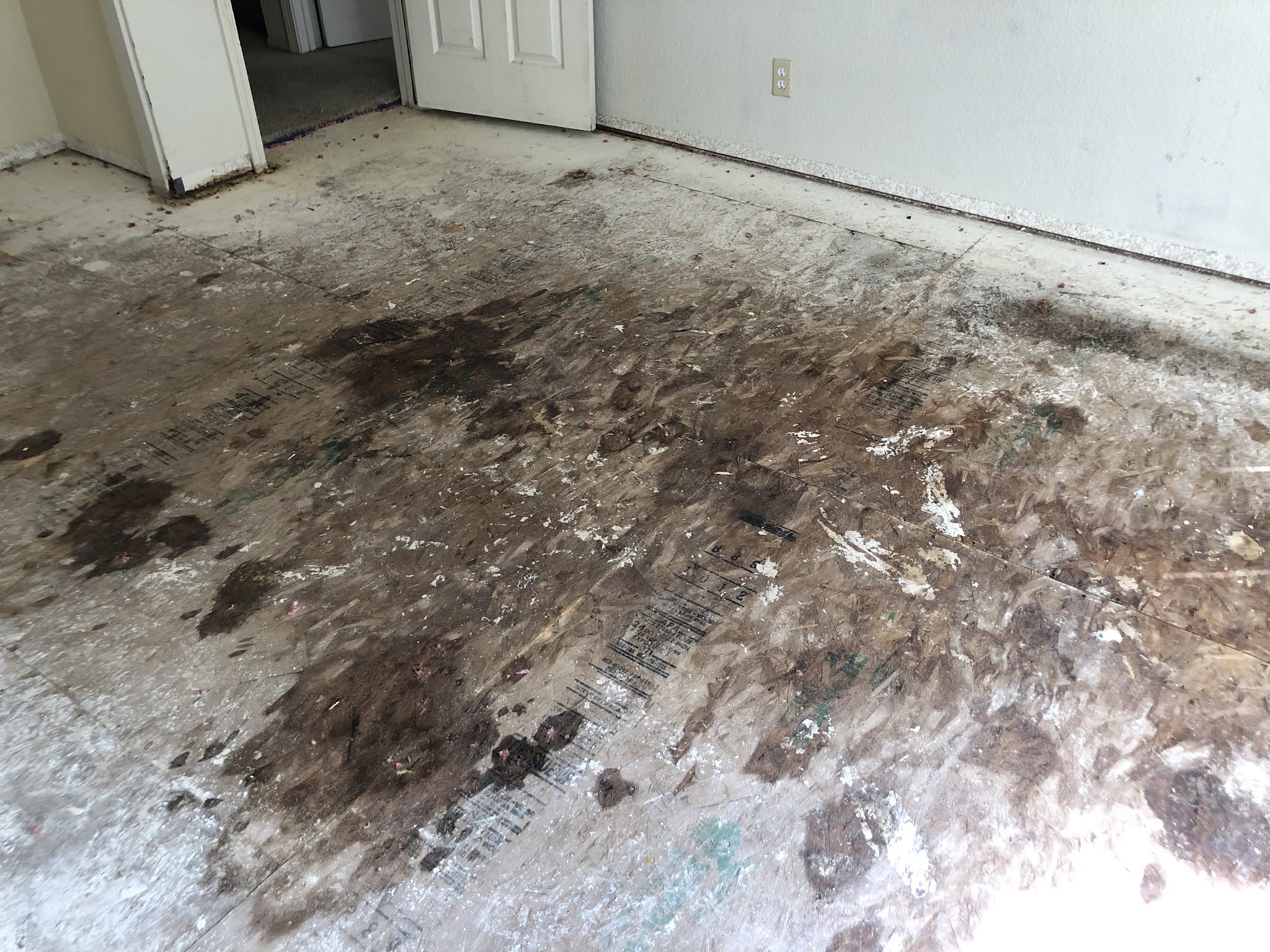
Excessive pet urine destroys stuff, in case you were totally wondering...

If a picture is worth a thousand words, then it must also be worth about an 9.0 magnitude on the Richter Scale of smell. 

Be glad you can't smell this photo, because your eyes would water and you might want to take an immediate shower.

This is an image of what the subfloor looks like after carpet and pad were removed from a bedroom where a tenant kept a dog who who urinated excessively in the house (in violation of the rental lease, of course). In preparing this home for sale, BEFORE new flooring could be installed in this room, a contractor treated the subfloor with an enzyme in an attempt to kill the odor. They then had to apply an oil based sealer. And then new carpet, pad, and baseboards were installed, and the room painted. 

To remove and dispose of the carpet, pad, tackstrip, baseboards and get rid of the smell cost about $750, plus the cost of reinstalling new flooring. Overall this owner was fortunate that the pet urine seemed to be isolated to this one room, because doing this treatment throughout the entire 2000sf+ home would have been ridiculously expensive. For what it's worth, this owner is replacing all of the flooring and painting the entire interior of the house, so everything will be crisp and clean eventually. And the seller will disclose this to buyers...

The moral of the story: housebreak your pets. Or don't have them...

Saturday, March 21, 2020

City Council for the City of West Sacramento approves a temporary moratorium on residential and commercial tenant evictions relating to hardships caused by COVID-19

A few days ago, on March 18, 2020, the City of West Sacramento's City Council adopted its own temporary moratorium on residential and commercial tenant evictions, provided those tenants suffer loss of wages or loss of revenue relating to COVID-19. This is not a free pass for tenants to skip rent. Tenants who can afford rent SHOULD PAY THE RENT. This ordinance allows financially affected tenants to defer rent payments until after the public health emergency period is over. The hope is that the tenants should be able to return to work at that time, or should be able to reopen non-essential businesses that were required to close.

Details of the new ordinance:

  • Effective Immediately, but not retroactively applied if tenant was already delinquent in rent
  • Moratorium applies to evictions due to nonpayment of rent due to COVID-19
    • For residential tenants, either: 
      • The tenant is sick with COVID-19 or has to care for a member of the household who has COVID 19; 
      • The tenant experienced a lay-off, loss of hours, or other income reduction due to COVID-19; 
      • The tenant complied with a recommendation from a government agency to stay at home, self-quarantine, or avoid congregating with others; or 
      • Tenant had to miss work to care for a home-bound school-age child. 
    • For commercial tenants, either: 
      • Commercial tenant’s business was required to close in compliance with a recommendation from a government agency; 
      • Commercial tenant experienced a substantial loss of business resulting from a state, federal or local emergency declaration; 
      • Commercial business owner is sick with COVID-19 or has to care for a member of the household who has COVID-19.
  • Tenant must do all of the following: 
    • Notify landlord in writing before rent is due that the tenant has a valid reason for delayed payment 
    • Provide verifiable documentation of a covered reason 
    • Pays the portion of rent owed that the tenant is able to pay based on the amount of income received. For example, if the tenant owes $1,500 in rent and the tenant suffered a $500 wage loss in March, the tenant would pay the landlord $1,000 for April rent. 
  • Rent is due to landlord at the conclusion of the moratorium:
    • Residential and commercial tenants who were afforded eviction protection under this Ordinance shall have up to 120 days after this Ordinance terminates to pay their landlord all unpaid rent. 
    • During that 120-day period, the protections against eviction found in this Ordinance apply for such tenants.
    • Landlord and Tenant may voluntarily agree to an alternate timeline for payment of rent due in arrears. 
This ordinance is an emergency measure that is in effect immediately through at least May 31st.

It is very similar to the eviction moratorium ordinance enacted by the City of Sacramento.

Here is a link to the ordinance language

Here is a link to a FAQ about the eviction moratorium.

Here is a link to the Delay of Rent Notification Form.

Wednesday, March 18, 2020

Sacramento City Council approves a temporary moratorium on tenant evictions relating to hardships caused by COVID-19

Our local elected leaders, responding to calls from tenant advocates to provide relief to renters experiencing hardship related to our current public health situation, enacted an ordinance aimed at preventing renter displacement.

Last night, the Sacramento City Council approved a temporary moratorium on tenant evictions relating specifically to COVID-19. Keep in mind, this applies to all residential rental units within the city limits of the City of Sacramento.

Details of the new ordinance:

  • Effective Immediately, but not retroactively applied if tenant was already delinquent in rent
  • Moratorium applies to evictions due to nonpayment of rent due to COVID-19
    • Tenant was sick or caring for COVID-19 family member 
    • Tenant experience layoff or other income reduction associated with COVID-19 
    • Tenant’s compliance with a recommendation from a government agency to stay home, self-quarantine, or avoid congregating 
    • Tenant needed to miss work to care for a home-bound school-aged child 
  • Tenant must do all of the following: 
    • Notify landlord in writing before rent is due that the tenant has a valid reason for delayed payment 
    • Provide verifiable documentation of a covered reason 
    • Pay the portion of rent the tenant is able to pay 
  • Tenant has 120 days after the termination of the Sacramento County public health emergency order to pay landlord all unpaid rent. 
    • Landlord and Tenant may voluntarily agree to an alternate timeline for payment of rent due in arrears. 
Here is a link to a Delay in Payment Notification Form provided by the City of Sacramento.
The County of Sacramento has not taken similar action as of now, nor have the other cities within Sacramento County.

Friday, January 3, 2020

As of January 1, 2020: SB 329 prohibits discrimination based on a tenant's source of income - which now includes Section 8 Housing Choice Vouchers

A new law took just effect on January 1st, 2020 that has not received as much publicity as other new laws aimed at tenant protection -- and that is SB 329 (Mitchell). This new law prohibits a landlord from rejecting potential tenants based on their use of a Housing Choice Voucher (often referred to as Section 8).

Up until now, landlords could choose not to work with Section 8, which is a federal housing subsidy program for low-income people. Landlords could advertise rental property declaring up front that they would not accept Housing Choice Vouchers. But no more.

Discrimination based on a tenant's "source of income" has already been a violation of the California Fair Employment and Housing Act, however housing vouchers were previously not considered to be part of a tenant's source of income since the subsidy is paid from an agency to the landlord directly. SB 329 changes the definition of source of income to include Housing Choice Vouchers (HCV).

So landlords -- you MUST NOT advertise that you will not accept Housing Choice Vouchers. This is now illegal. You may still have other application standards, such as a minimum credit score requirement, a requirement for no prior court evictions, etc. but you must be sure that you uniformly apply these standards with all prospective applicant tenants. Many properties will have a higher market rent than the maximum allowable rent for the property type and zip code. So while in some cases it is likely the property will not be a viable candidate for a voucher recipient, you still may not advertise blanket rejection of HCVs.

For full disclosure, I myself am a landlord and one of our tenants is a HCV recipient. This tenant has now rented from us for about 3.5 years and has been a great tenant. Jumping through the initial hoops of the HCV program was a real pain. It can take several weeks or months prior to the tenant's occupancy of a property to get through all the layers of paperwork, inspections, and repairs to make a property eligible for occupancy. There are also subsequent property inspections and interim paperwork requirements as well. But, the HCV rent payment magically appears in our bank account at the beginning of each month, and our tenant has never been late paying her small part of the rent that is proportional to her monthly income.

Overall for myself I'd characterize it as a positive experience, and I personally am so glad that we can offer some housing stability to a family who needs it...although I am personally generally not a fan of the government forcing mandatory compliance with its onerous programs. But I do urge landlords to keep an open mind with the HCV programs and just be prepared for a lot of up-front flexibility. I do believe the agencies who administer the HCV programs have done what they can to streamline the processes. In Sacramento County the program is administered by the Sacramento Housing and Redevelopment Agency (SHRA).

I can only hope there are not obvious unintended consequences of this legislation, such as application requirements for rented properties getting much more stringent -- like minimum credit scores increasing for everyone, for example. That overall will make it more difficult for renters to secure housing.

Wednesday, October 9, 2019

In addition to City of Sacramento's rent control ordinance, for more fun, now we have statewide rent control in California as AB1482 is signed into law...

I have been holding off pushing the "publish" button on this post until California's Governor Gavin Newsom actually signed AB1482 into law, and since he finally did so yesterday, here you go.


California now has a statewide rent control and just cause for eviction. And nearly simultaneously as I wrote about a few weeks ago, the City of Sacramento passed a local rent control ordinance that is essentially rolling out at the same time.

I am not looking forward to the confusion these two parallel rent control programs will cause in and around Sacramento. The provisions in both are similar, yet different. And while I am not an attorney, I imagine that within the city limits of Sacramento where the terms overlap, the higher level of tenant protection will prevail.

AB1482 statewide rent cap limits annual rent increases to 5% + regional CPI (inflation adjustment), applies to newer construction on a rolling 15-year basis, and after tenancy for one year provides for relocation assistance in the amount of one month's rent to terminate a tenancy (this is known as just cause for eviction).

So for example, within the city limits of Sacramento, while single family homes are exempt from the local rent control ordinance, because the statewide rent control applies single family homes owned by larger investors (LLC's owned by corporations, or individuals who own more than 10 properties), some single family homes in the city may be rent controlled by the new state law. Additionally, the state rent cap allowable increase percentage is actually LOWER than the city's...so I imagine the lower of the two will be what goes.

So basically, it's complicated. If you care to read it, here is the bill language for AB1482, as well as the ordinance for the City of Sacramento.

In addition, landlords will be required to provide their tenants a disclosure about their rights under the new ordinance by January 1, 2020. The California Association of REALTORS is coming out with a standard form for this, and I imagine the California Apartment Association will too, among other rental housing organizations...if you have a professional property manager you should inquire to make sure they are ready to be in compliance with this requirement. And if you self-manage your properties, you should perhaps get some legal advice.

If you are thinking about selling an investment property or any tenant occupied property, please connect with me so we can strategize the best way to move forward in compliance with these rent control ordinances.

Regardless of your stance on rent control policies, these are here to stay for a while. The state law sunsets December 31st, 2030, which is more than a decade away...

Friday, September 6, 2019

City of Sacramento passed a rent control ordinance -- here are the basics...

The City of Sacramento passed a new rent control ordinance last month that will be rolling out very soon. I think there may be confusion among local landlords and tenants alike as this is implemented. This ONLY applies within the city limits of Sacramento, which is a very specific area...there are areas within the unincorporated county of Sacramento where the ordinance will not apply, and there are many residents of those areas who do not realize the difference between city and county jurisdiction. Here is a map of the affected areas:
I think confusion will be highest in areas with Sacramento addresses that are outside of the city limits. For example parts of town such as the Arden / Arcade areas, some parts of Natomas, areas near the Oak Park neighborhood, Rosemont, South Sacramento, Foothill Farms, etc all have Sacramento addresses but are actually located in the unincorporated county though are adjacent to the city limits. Those areas are not affected by this rent control ordinance.

If you have trouble sleeping, you can read the full text of the adopted ordinance here. Here are the highlights of the new ordinance that will be in effect in the coming week:

  • Allowable annual rent increase is set at 6% + CPI (inflation adjustment), hard cap not to exceed 10%
    • Base rent is set at what the landlord charged as of July 1, 2019
    • Only 1 rent increase allowed every 12 months
    • Single family homes are exempt
    • All units built after February 1, 1995 are exempt
  • Just cause for eviction. After 1 year of occupancy, owners may only terminate tenancy for cause (like failure to pay rent or illegal activity), OR may only terminate tenancy with 120-day notice for the following reasons:
    • To make substantial repairs (must offer tenant first right to return) 
    • Landlord or immediate family moves into the unit 
    • Landlord withdraws all of the units in the building from the rental market for at least one year.
The ordinance will sunset on December 31, 2024 unless extended.

For added fun, there is a statewide rent cap bill, AB1482, making its way through the legislature right now. It will be interesting to see if there is the political will to make rent control a statewide policy. We shall know on that one in the next month.

If you are thinking about selling a rental or investment property in the city limits of Sacramento that falls within the jurisdiction of these rent control ordinances, please reach out to me right away so we can strategize how to sell the property in compliance with the ordinance.


Saturday, February 24, 2018

New flooring and fresh paint can be a huge improvement and help maximize your selling price when preparing a home for sale...

Often, I list property for clients where the home has been occupied for many years and then is vacated before the listing goes on the market. Perhaps the seller purchased another home first, moved out, and then listed the home. Or in other scenarios, the property was occupied by tenants who did not leave the home in stellar condition. Whatever the case, sometimes after a long term occupant, a vacant home will not look or smell its best.

Case in point: in an upcoming investment property listing, the tenants vacated the property after living there 8 years. I viewed the property while the tenants were still living there and thought to myself that once they moved out the unit would probably just need a deep cleaning and would ready for market. It became clear after they moved out though, that the unit needed more than a deep cleaning. Their possessions masked the rips and stains in the carpet, and there was a distinct pet odor that remained. Also, after 8 years the white walls were really dingy. 

My sellers live out of the area, so I met my go-to contractor at the home and he bid replacing the flooring and repainting the interior, among a few other repairs. The before and after differences are amazing! The unit is now ready for occupancy, whether by a new owner occupant or new tenant. 

It does not always make sense to make improvements to a home before listing it though...depending on numerous variables, such as the target buyer for the property, overall condition of the home, the location of the property, and overall market conditions, a seller might be better off selling the property in its current condition. I of course help advise my clients accordingly. It is my goal to maximize the return on any pre-sale repairs or improvements, and sometimes that means it does not make sense to do much, if anything. Or, as in this case, spending some money up-front should yield a three-fold return on the investment with a much higher selling price.