Showing posts with label Escrow. Show all posts

Friday, June 24, 2022

Own or purchasing a property with racially restrictive covenants? Apply for a Restrictive Covenant Modification...

If you are buying a home and review the Preliminary Title Report, you may notice a new disclosure from your title/escrow company that accompanies the section of the report that covers the Covenants Conditions & Restrictions (aka, CC&Rs -- which are essentially the developer-imposed rules that govern a community). This disclosure was born from California Assembly Bill 1466 (McCarty) which created a process to provide home buyers information to proactively remove racially restrictive covenants at the time of purchase. This disclosure will be required starting July 1, 2022.

Sadly, the CC&Rs for many properties built in and around Sacramento County that were developed prior to the civil rights movement contain racially restrictive covenants. I sell several homes per year where the CC&Rs contain these covenants. I come across some really repugnant restrictions that were intended to permanently racially segregate neighborhoods. And I think most home buyers and homeowners are unaware these covenants exist.

Have you ever seen a racially restrictive covenant? They are horrifying. 

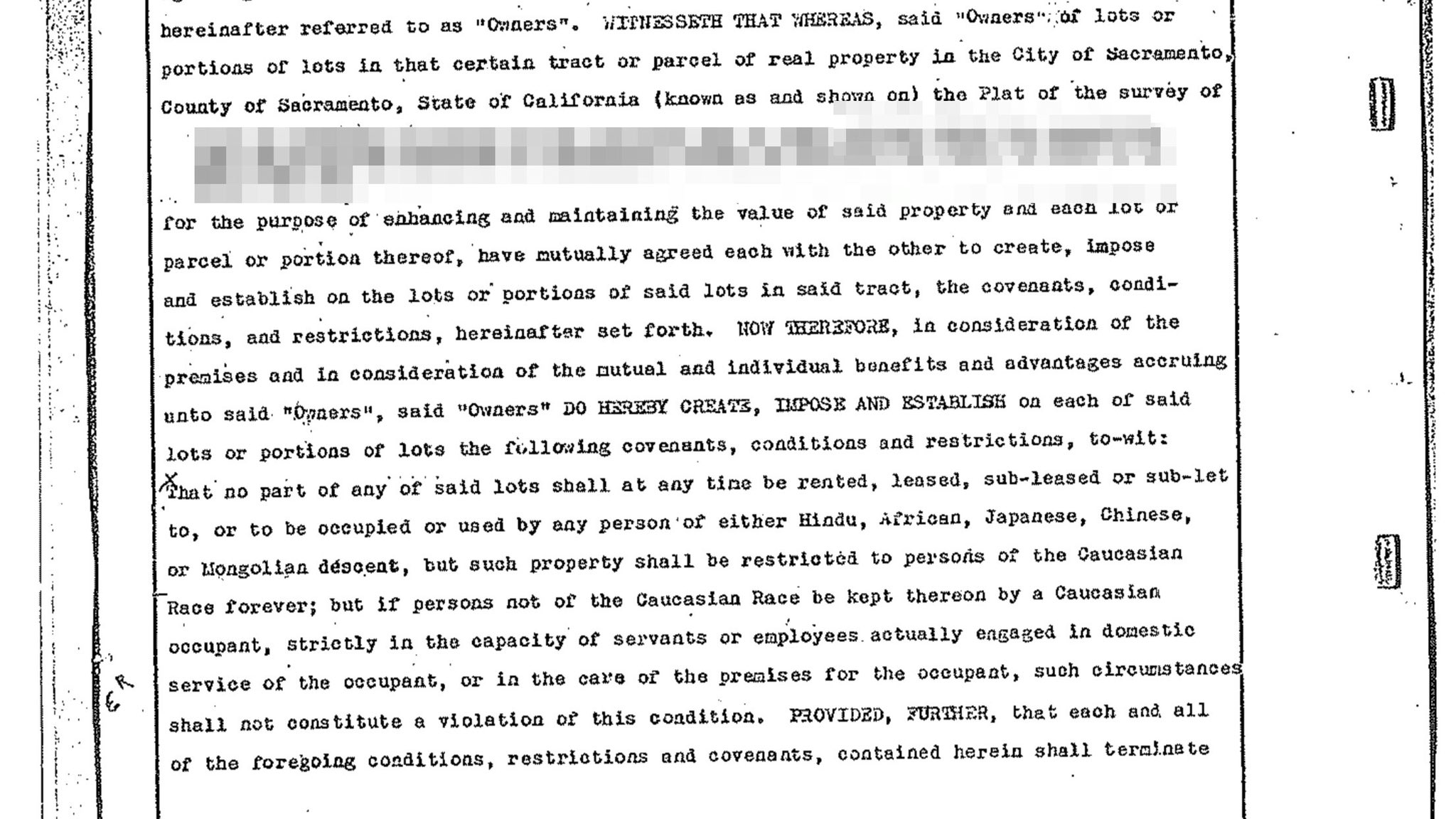
A couple years ago I was interviewed by Capital Public Radio about racially restrictive covenants. Here’s a snapshot of the CC&Rs of a property I sold that was built in 1944. “...but such property shall be restricted to persons of the Caucasian race forever.”

These CC&Rs are now legally null and void, however these records stay with the property even though they are unenforceable. Counties have an application process to remove racially restrictive covenants. Most home buyers and homeowners are unaware of this process, and I hope that this new legislation helps create awareness. Here are links to local county websites to their applications and more information:


If you are interested in the history of racially restrictive covenants, books like The Color of Law provide an overview. 

Tuesday, March 17, 2020

Coronavirus and Sacramento real estate...

I was interviewed by Tony Bizjak of the Sacramento Bee a couple weeks ago about how Coronavirus was affecting the Sacramento real estate market at that time, and when the story ran in the March 7th edition of the Bee, my answer was that the real estate market was super active. I had written offers for clients, among MANY multiple offers, and at that time there was no lack of enthusiasm for real estate.

On this last Friday, I closed two transactions, and my buyers were absolutely thrilled. Instead of sharing hugs, we shared congratulatory elbow bumps instead.

Today is Saint Patrick's Day. 10 days since that article ran, and just a weekend after handing keys to excited new homeowners. I feel like a lot has happened in that time. 

But I am happy to report that I can still do my job. And so can the other professionals connected to real estate transactions in Sacramento. Realtors can still show property. Lenders can still underwrite mortgages. Appraisers can still visit properties to value them. Insurance agents can issue homeowners insurance policies. Inspectors can still inspect properties. Contractors can still make repairs. Escrow officers can still notarize loan documents. And the Sacramento County Recorders Office is still open for business to record new deeds for property change of ownership transfer.

Other parts of our state are not so fortunate. For example, some California county recorder offices have closed to the public or reduced public operating hours, which may have an impact transaction closings.

But right now in Sacramento and our surrounding counties, we can transact. I had multiple offers on my new Carmichael listing this weekend. And I wrote an offer for a buyer that was one of many on a property in Folsom. People still need to buy and sell, people still want to buy and sell, and I don't think Coronavirus changes that, though it may put a new filter on things for a while. 

A week ago I had few if any concerns about being able to close a real estate transaction. And today, we are still open for business, though some contractual nuances may take extra time. Right now, all systems are go. But we have to be deliberate with what we are doing. I emailed my active buyers these thoughts just this morning:

"If there is a home you want to see, we need to be pretty deliberate about setting showing appointments, wiping doorknobs, keeping appropriate “social distance” etc. I’m mostly working from home at this point, and luckily things like Docusign can allow us to do paperwork and a lot of our functions virtually. As of now, lending, escrow/title, appraisal, inspection, and county recorder functions are all running, so while we may have to be deliberate and might move a little slower with scheduling certain things (some of them are working from home too), we can all still do our jobs at this point. And interest rates are insanely good right now, which is a bonus. If anything in that realm changes I can let you know. I’m optimistic we can all go back to business as usual in the coming weeks. Let me know if you have any questions or concerns. And while buying a house may not be your top priority at the moment, if something pops up, I’m here and healthy."

I'm super thankful to be in good health, not part of any at-risk group, and pretty well-stocked up on Clorox wipes and hand sanitizer. 

This too shall pass.


Thursday, January 24, 2019

Acceptable forms of providing an escrow company your initial deposit funds or downpayment for a real estate purchase...

So there is a first time for everything, and this week a client asked me something I have never before been asked: if he can send his downpayment funds via Venmo. In the age of money transfer apps, that is a totally legit question.

For those of you who don't know, Venmo is a popular money sending/transferring app. My husband and I have a Venmo account...and our most frequent use for Venmo? Loaning his 20 and 23-year old sons gas money every once in a while, or occasionally reimbursing a friend or colleague for a meal. There are other money sending apps -- PayPal is sort of the "old school" one, and some banks offer a feature called Zelle that essentially does the same thing. There are probably other ones too. 

These apps can be super convenient obviously, but will escrow companies (the neutral 3rd party that facilitates the transfer of title and handles the funds) accept funds transfers from them for initial deposits and downpayments for real estate purchases? The answer is -- NO. They will not.

And you might wonder why...well for one, you cannot just walk a bag of cash into an escrow company either. Escrow companies are themselves financial institutions, which in California at least are heavily regulated, usually by the California Department of Business Oversight. Venmo by its own admission is not set up for business transactions. Additionally, the amounts typically involved in real estate transactions to purchase homes or investment properties tend to be pretty large. Most of these apps have daily or weekly limits that prevent transfers in excess of a few hundred or a few thousand dollars. And with that, while I believe Venmo transactions may be free if linked directly to a bank account, many of these accounts charge significant transaction fees -- up to a few percent. If you were to send your $75,000 downpayment via one of these apps, the sender or recipient might be charged a couple thousand dollars in these fees alone.

These accounts are often linked with credit cards, so I am not sure it is advisable to "charge" your downpayment. In fact I am sure your lender would not like this at all as it could significantly change your loan debt-to-income ratio. Security of these transactions is potentially also a concern. While transactions are probably encrypted, it is not difficult for hackers to hijack a phone where the app lives, or what if you physically lose your phone logged into your app's account with a large fund balance awaiting transfer? Additionally, when sending or receiving funds via Venmo, your transaction history is public. Do you want the world to know you just sent a large sum of money to an escrow company? Also, funds on deposit at banks are FDIC insured and funds that live in these apps are not. 

Your best bet -- physically walk into your local bank or credit union branch and arrange for a wire transfer of your funds to the escrow company. Depending on your account type, these wire transfers may be free, or you may be charged a small fee of perhaps $25-$35. You may also obtain a cashier's check from your bank and walk that into an escrow company. 

While these bugs with money transfer apps may be worked out sometime in the future, for now I do not anticipate escrow companies to rush out and create Venmo, PayPal, Zelle, or other accounts. But perhaps this is something to consider as attitudes and culture shifts.

Thursday, March 15, 2018

How to fill out a Short Sale Addendum

I have a new short sale listing coming on the market in the next few days, and it seems that over the last few years, other agents and buyers have forgotten how to do them. In the time period from 2007 - 2012 or so, it seemed like ALL my listings were short sales. I know them backward and forward, how different types of short sales work, how different mortgage companies and banks process them, and more. Short sales are not a huge part of our Sacramento real estate market anymore...but they are still out there.

So - here is a primer on how to fill out a Short Sale Addendum (C.A.R. Form SSA) and what it means to buyers and sellers.

First, this form must accompany any offer on a short sale listing. This document establishes that the property is being sold subject to the mortgage company's approval of a payoff for less than the amount owed, defines timelines and other parameters in conjunction with the Residential Purchase Agreement. Generally, the SSA discloses that there is no guarantee of approval, that the buyer and seller pay incur costs that are not recoverable in the event the mortgage company(ies) does not approve the transaction, and that the parties may want to obtain tax or legal advice. Aside from that, there are three fillable components that may change the dynamic of the short sale transaction that I want to cover.

Paragraph 1A: SHORT SALE APPROVAL - this timeline indicates the period in which the buyer is willing to wait for the mortgage company to provide written approval for the short sale. This timeline commences upon the seller's acceptance of the offer, and the buyer MUST wait during this timeframe for a response from the mortgage company. In other words -- the buyer CANNOT cancel prior to the timeline in this contract simply because the buyer gets tired of waiting. There may be other contingency timelines that permit cancellation before this period expires, but otherwise the buyer is in contract with the seller and is obligated to wait it out. For a seller of a short sale, you want this timeline to be as long as possible. As a short sale listing agent, I like to see a minimum of 60 days. Ideally the short sale will not take that long for mortgage company approval, however short sale timelines are a bit of a moving target.

Paragraph 2: TIME PERIODS - this indicates when the buyer's contractual contingency timelines will begin. Checking the box for "shall begin as specified in the agreement" is what I prefer as a listing agent. This means that buyer investigation contingencies, appraisal contingencies, loan contingencies, etc. all would begin once the seller accepts the offer (which is BEFORE the short sale mortgage company consents to the short sale). As a short sale listing agent, I want the buyer to conduct inspections, appraisal, loan underwriting, etc. right away. If this box is unchecked, then the buyer's timelines do not start until the mortgage company has issued short sale approval. The sooner the buyer removes contingencies, the better. If timelines do not start upon seller acceptance, then it is possible for the buyer to walk away after we have short sale approval. We do not want to get several months into a short sale and lose the buyer over something relating to condition of the home. If a buyer cancels we want that to happen early so we do not have to take too many steps backward before moving forward again.

Paragraph 3: BUYER'S DEPOSIT CHECK - this indicates when the buyer's initial deposit should be held in escrow. Checking that box for "as specified in the agreement" is what we want to see. This means that within 3 business days of seller acceptance, the buyer's initial deposit is held in escrow (which again is BEFORE the short sale mortgage company consents to the short sale). As a listing agent, I want to see this for a few reasons. One, if the buyer is willing to do this, it indicates they are serious buyers! Two, if the buyer gets sick of waiting and wants to move on, they will want their deposit back. If escrow is not holding a deposit, the buyer can move on and simply never tell us. That would be bad. Three, holding the buyer's deposit upon seller acceptance looks fantastic to the short sale mortgage company. Four, if the buyer removed contingencies (as we discussed in paragraph 2) and then decide before the timeline in paragraph 1A is over, then the seller may have the right to retain the deposit.

Not all buyers of short sales are willing to do all three of these things I recommend. In non-competitive situations, many buyers will not agree to do all of these things...in multiple-offer situations, often buyers will agree. It is all negotiable. Hope that helps!

Friday, December 30, 2016

Verify wiring instructions before you wire funds to escrow...

So luckily I have not experienced this first hand with any of my clients, however I know other agents who have clients that have fallen victim to this. Beware...falling victim to this scam can not only derail your home purchase, but also completely derail your life.

BUYERS: WHEN YOU WIRE YOUR DEPOSIT OR DOWNPAYMENT FUNDS TO ESCROW, BE SURE TO VERIFY THE WIRE INSTRUCTIONS AND ROUTING INFORMATION WITH YOUR AGENT AND ESCROW DIRECTLY.

I can not emphasize this enough. If you receive an email with wiring instructions, call and personally talk to your agent to verify the information is correct and legitimate.

Sadly enough, there is an online email scam that seems to be getting more prevalent. Criminals will hack into a real estate agent's email and just sit back, read the emails, and monitor activity and the progress of transactions...then, when it comes time for a transaction to close, the hacker will use the agent's email and send wiring instructions to the client -- impersonating the agent. The wiring instructions lead to offshore bank accounts, not to escrow. One funds are wired to an offshore bank account, they can not be recovered.

Again, this is not some rumor. I know real people this has happened to. I know an agent whose client wired over $100,000 to Nigeria -- lost and gone forever. Don't let this happen to you! I have recommended to my buyers NOT to wire funds at all, and obtain cashiers checks and deliver them to escrow directly. The California Association of Realtors has a new advisory/disclosure document that addresses this as well. Just be careful.

Thursday, August 1, 2013

What items are included, OR specifically excluded from a home sale?

I am frequently asked -- what items typically are included in the home sale? The answers may seem obvious, but you might be surprised how often buyers and sellers are not clear on what stays and what goes. What is considered personal property, and what is considered part of the "real property", meaning part of the house, or aka, a "fixture." A few years ago, I blogged about a seller who wanted to take a hard-wired fountain and an arbor that was rooted into the ground...

First, I generally refer folks to review paragraph 8 in the California Residential Purchase Agreement; "Items Included or Excluded from the Purchase Price." This paragraph describes what is included or excluded from the sale and formalizes anything out of the ordinary that is included or specifically excluded from the sale.

To quote the language in paragraph 8 of the contract:
"8. Items Included or Excluded from the Purchase Price
A) Note to Buyer and Seller: Items listed as included or excluded from the sale in the MLS, flyers, or marketing materials are not included in the purchase price or excluded from the sale unless specified in 8B or C.
B) Items included in the sale
(1) All EXISTING fixtures and fittings that are attached to the property;
(2) EXISTING electrical, mechanical, lighting, plumbing and heating fixtures, ceiling fans, fireplace inserts, gas logs and grates, solar systems, built-in appliances, window and door screens, awnings, shutters, window coverings, attached floor coverings, television antennas, satellite dishes, private integrated phone systems, air coolers/conditioners, pool/spa equipment, garage door openers/remote controls, mailbox, in-ground landscaping, trees/shrubs, water softeners, water purifiers, security systems/alarms; (if checked () stove(s), () refrigerators;
(3) The following additional items:__________________
(4) Seller represents that all items included in the purchase price are, unless otherwise specified, owned by seller.
(5) All items are to be transferred free of liens and without seller warranty.
C) Items excluded from sale: Unless otherwise specified, audio and visual components (such as flat screen TVs and speakers) are excluded if any such item is not itself attached to the property, even if a bracket or other mechanism attached to the component is attached to the property; and _________________."

Just to point out a few key items in that paragraph...first regarding 8A -- just because the seller and listing agent discussed excluding something from a transaction, that doesn't mean it's actually excluded from the sale UNLESS it is noted in your contract with the party buying the home. You might note in MLS that your antique dining room chandelier doesn't stay, but if it's not in your contract, you will have a problem.

Regarding 8B2 -- you would be shocked how many sellers think it's ok to remove these things after entering into contract with a buyer. Or perhaps they lease their alarm system and can't include it in the sale. Discuss these things with your Realtor up front, or the seller may end up buying out the remaining lease on the alarm system at the last minute so it can be included in the sale to the buyer. Yikes!

To add items into the contract that may not otherwise be included, they need to be specifically included on the fill-in line on 8B3. So for example if you want to include the washer, dryer, and refrigerator in the sale, or a free-standing hot tub, it should be written in there. Include specifics and if you run out of space, reference an addendum.

To exclude an item that would typically be included in the sale, it should be written into 8C. If you received that rose bush as a wedding present and want to dig it up and take it with you, make sure it is written into that space. Or your specially made curtains. Or your dog-shaped mailbox. Or your built-in kegerator. You get the idea...

My typical suggestion to buyers or sellers -- when in doubt, just put it in the purchase contract. It's awful to have to deal with these sorts of disagreements at the close of escrow.

Monday, December 27, 2010

Short Sales: Who pays for what...

I receive several calls per week from homeowners that are looking for information regarding Sacramento short sales, and aside from wanting to know about the process itself, one most common questions I get from them pertain to if the sale will cost them anything out of pocket, if so, then how much, and generally, who pays for what fees. Having successfully closed several short sales, I will tell ya'll what I know to be true based on my experiences.

-Who pays the real estate agent commissions? In a short sale scenario, the lender(s) who agree to forgive debt and allow a short payoff of the loan(s) pay for the real estate agent (or Realtor) commissions - generally by absorbing the costs of the commissions out of the proceeds of the sale. As a side note, often times these commissions are re-negotiated by the lender(s) during the process. Note: Real estate commissions are always negotiable and NOT set by law or local custom.

-Who pays title insurance, escrow fees, and transfer tax fees? These are negotiable between buyer and seller when the offer is initially negotiated (before it is submitted to the lenders for approval). For example, perhaps the buyer and seller agree initially that the seller will pay for 100% of title insurance and escrow fees, 100% of county transfer tax, 50% the city transfer tax. The lender(s) may negotiate that the buyer pay a different split of these fees...however the portion that is paid by "the seller" is absorbed in to the overall debt forgiveness and short payoff. Occasionally you will see a lender agree to pay one of these fees, up to and not to exceed a certain amount (for example, they may agree to cover up to $750 of the escrow fee that costs $1200). Generally then, the buyer would cover the unpaid portion of that fee. So basically, again, the lender(s) will absorb many of those types of fees.

-Who pays for a home warranty? This is negotiable between buyer and seller when the offer is initially negotiated (before it is submitted to the lenders for approval). Generally though, I would prepare any buyer of a Sacramento short sale property to expect to pay for this cost, even if you ask the seller or short sale lender to cover it. In my experience, this is paid by the short sale lender in less than 20% of my approved short sales.

-Who pays for inspections or certifications? These are negotiable between buyer and seller when the offer is initially negotiated (before it is submitted to the lenders for approval). Again, most short sale lenders will not agree to cover things like pest or termite inspections, roof inspections, sewer line inspections, or any corresponding certifications. A lot will depend on the circumstances with the condition of the property, how many loans are involved, the buyers' loan program, if the property is in default, the length of time of negotiation, etc. As a safety net - buyers, do not expect that lenders will grant these requests. Generally short sale properties are sold "as-is" and sellers can not afford to make repairs anyway.

-Will the lender(s) give the buyer credits for closing costs? These are negotiable between buyer and seller when the offer is initially negotiated (before it is submitted to the lenders for approval). I have seen this vary widely from the short sale lender(s) agreeing to pay up to 6% closing costs for the buyer (including an instance of seller-funded downpayment assistance...which is no longer possible thanks to past legislation), to the short sale lender(s) rejecting those requests. Again, much will depend on the circumstances surrounding the sale of the property.

-Who pays delinquent property taxes or liens? Sellers - if you have not been paying your property taxes or county utilities, you really need to let your agent know this ASAP! I work closely with the title company on this to make sure that we know of any lien issues in advance, but because it can take several weeks or months to get approval, new liens may pop up during the lender negotiation process. When I negotiate short sales, one of my worst fears is that after the short sale is approved an unexpected lien will pop up. This has happened to me before, and for lack of a better way of describing it - this sucks! If you can let your agent know in advance that these items are unpaid, it will save lots of headaches all the way around. IF WE KNOW in advance that these liens exist, there is a great chance that the short sale lender will absorb these costs into their overall debt forgiveness and short payoff. IF WE DO NOT KNOW in advance that liens exist, once the short sale is approved - this will halt the transaction until we can find a way to pay these liens. The seller is often financially unable to pay them, the buyer does not want to pay, the agents commission has already been reduced, and the short sale lender has already taken a loss on the loan. Sellers - please save everyone a headache and communicate with your agent.

To make a bit of a sweeping generalization, the seller usually pays nothing out of pocket to close the transaction unless specifically asked to by the lender(s).

In perhaps one instance out of every six short sale transactions I close, the lender will request that the seller make a cash contribution to close the short sale. In these instances that I have negotiated, the sellers have had cash in the bank and were financially able to make that contribution...in those instances, the lowest cash contribution one of my short sale sellers has contributed was $1,000, and the highest was $5,000.

Also, you should note that in some short sale scenarios, the short sale lender will actually pay the seller "relocation assistance" to close the short sale. I have seen this in the range of $1,000 - $5,000. Not every Sacramento short sale transaction will qualify though.

Hope that answers some frequently asked short sale questions...cheers!

Wednesday, March 24, 2010

Trying to sell a house in Living Trust? MAKE SURE your house is actually included in the Living Trust. No really.

If you follow me on Twitter, you will already know that I have had the great displeasure of working through a pretty random "Title" issue on one of my listing transactions...and then the same issue to occured on another one of my buyer transactions! All within the course of a week's time!

So a little background. In both instances where I am experiencing this issue, the homeowner had passed away, leaving their heirs (or if you want to get technical, the "Successor Trustees") the responsibility to deal with the estate, including selling the home. Under normal circumstances, the Successor Trustee has full authority to list the property for sale, and sign a new Grant Deed to transfer title to a new buyer.

So regarding the first instance of this title issue...I am representing a seller - aka, the Successor Trustee of his father's Living Trust. This man's father passed away in January, and the seller is in Sacramento (he lives in Puerto Rico) dealing with his father's estate. He wanted to list the house immediately. He informed me that he had full authority per the Living Trust to sell the home. When I looked in the tax records, it appeared that the name on the title of the property was an individual, rather than the name of the Living Trust itself. OK. So I asked Placer Title Company to provide me with a property profile....sure enough, the title to the property was held in the name of the deceased father. The seller was frustrated...the house was specifically named in the Living Trust as being owned by the Living Trust, so what was the issue? Well, in order for the Living Trust to actually own the house, and for the Successor Trustee to have full authority to sell the house, a new Deed naming the Trust MUST HAVE been recorded at the county recorder's office. And that had not been done.

So regarding the second instances of this title issue...I am representing a buyer of a property whose owner had passed away. I received a copy of the preliminary title report from the title company, and it again named an individual as the property owner, rather than a Trust entity as the owner. Inspections were completed, the transaction was rolling forward nicely, and the buyer's loan documents on the way...BUT the Successor Trustee can't sell the house, because again he does not have full authority to do so, because a new Deed naming the Trust as the property owner was never recorded. UGH.

So what do we do to remedy this situation? Well, the Successor Trustee must schedule a Sacramento County court hearing, and file what is known as a Heggstad Petition so that the home does not have to go through the probate process. This process, from what I have been told, can take about two months from start to finish.

My seller client in scenario one has this Heggstad Petition process underway, and we are not listing it until he has been granted full authority. Definitely an inconvenience, as the seller wants to get back to his life in Puerto Rico...but our proactivity will be rewarded with the ease of being able to list and sell the home in a few weeks.

My buyer client in scenario two, however, is getting the short end of the stick. We are just a week from our scheduled closing, and the Heggstad Petition process is just now getting underway. He will loose his interest rate lock. He must postpone his move. UGH.

The moral of the story - if you have a Living Trust, or are planning to create one, PLEASE be sure to record a new Deed so that not only is the house named in the Living Trust, but so that the Living Trust actually owns the house! If you have an elderly parent, it probably makes sense to check to see if this has been done for their trust. You will potentially save yourself lots of time and money later.

Sunday, March 14, 2010

Buyers - having trouble getting into contract on right house? The solution may be a more creative Realtor...

If you read my blog post about my little vacation from last week, you will know that I closed a buyer transaction in Garden of the Gods. I wanted to share a little success story about how this transaction came to be, but wanted to wait until after the close of escrow as to not jinx the outcome!

If you are a Sacramento area home buyer, you will know that certain price ranges and certain neighborhoods are extremely competitive - often with properties getting multiple competing offers. My buyer clients were planning to relocate from the bay area to Sacramento, and specifically wanted to live in the Garden of the Gods neighborhood. Unfortunately, at the time they were looking (this was in January), there were only 4 active listings in Garden of the Gods. They wanted to buy sooner rather than later, as they were first time home buyers - and they wanted to take advantage of Federal Home Buyer Tax Credit that is available if they were in contract by April 30th, and closed by June 30th, 2010.

So I put on my thinking cap...

I went into MLS and looked up past listings - ones that did not sell for one reason or another, and were eventually withdrawn or expired. I found a property that had been on the market last summer that seemed to be exactly what my buyer clients were looking for. It was not a foreclosure, and not a short sale either! I called the former listing agent and asked if those sellers were still interested in selling the house. YES of course, she said, and they were planning to re-list it later in the spring. I arranged a showing of the house for the last weekend in January. The house was not on the market.

We toured it, and my buyer clients LOVED the house. We immediately went back to my office and wrote an offer. The sellers then countered, and my buyers accepted the seller's counter offer.

SO.....my buyer clients were able to purchase a great home that fit their needs that was not on the market, in a neighborhood with very little listing inventory, in a non-competitive situation. Given the current brisk, competitive state of the market in that neighborhood and in that price range, what could be better than that? A win-win for everyone involved!

The bottom line - get creative! There are ways to circumvent the market conditions. The buyer's agent will have to do a little more work in order to make this happen, but if you have a Realtor that is not savvy enough to do this, or not willing to go the extra step, you may be working with the wrong Realtor.

Tuesday, March 2, 2010

Like a mullet; business in the front, party in the back!


So if you know anything about me personally, you will know that I am a big goofball. I am definitely very professional in the business and real estate environment, however I do like to have fun in pretty much everything I do. I also like to surround myself with like-minded people, so the folks I work with in my transactions on a daily basis are generally very professional as well, but have silly sides.

Case in point. The escrow officer I like to work with at Placer Title is one of the most organized and thorough escrow officers that I know...with all of my short sales and such, it is critical that the escrow officer I work with be really on top of things, and bless Anne Chatfield, she is! In addition to being the great escrow officer that she is though, she has a great sense of humor and is pretty darn hilarious.

So early last week, I was having a minor medical procedure (nothing serious), and had to have blood drawn first thing Monday morning. Over the weekend, I had successfully negotiated an offer on one of my listings, and forwarded the fully executed contract over to Anne so she could open escrow. So in the waiting room I sit, checking my email on my iPhone. I received a very dry email from Anne, cc-ing the buyer's agent, with the escrow information. I replied to her that those types of dry emails make me laugh because that generally is not how we deal with each other. She quickly replied - "It's my "business" side! I am like a mullet- business in the front and party in the back!" Let's just say my outburst of laughter in the middle of the quiet lab waiting room startled several of the other folks in there.

Well now, I certainly can't let a gem like that one go unnoticed, can I? Once I got home later, I went to Amazon.com and ordered an inexpensive Mullet wig and had it delivered to Anne at her office. What a great sport...she wore it and emailed me a photo! Our joke now is that she will have to wear it at the next escrow signing she does for one of my clients! Hmm...wonder who my lucky client will be?

Saturday, December 19, 2009

Fannie Mae - NO LONGER POSTPONING TRUSTEE SALES!


I received an alarming email yesterday from my favorite Escrow officer. She forwarded me a memo from their legal department:

"One of our escrow officers received a correspondence yesterday on a FNMA (aka, Fannie Mae) short sale escrow that indicated that FNMA has implemented a new policy effective today, 12-15-2009 that they will no longer postpone trustee sale dates. FNMA is requesting that the short sales are closed before the sale date. If they can not close the short sale before the Trustee Sale date, the property will go to Trustee sale and be foreclosed."

What exactly is a Trustee Sale, you ask? A Trustee Sale is basically a Foreclosure Sale conducted under the stipulations of a Deed of Trust. The Deed of Trust is a notarized document a borrower signs that secures the borrower's loan to the property, and permits the sale of the property upon default by the borrower. Upon default, the Trustee (could be the lender, or the lender's authorized agent) is authorized to foreclose the mortgage and put the property up for a Trustee's Sale. The proceeds of the sale are distributed by the Trustee according to the priorities listed in the deed of trust...usually first distributed to the 1st lender, and then any remaining proceeds (if any) are distributed to the 2nd lender, or any junior liens. After the sale is complete, the trustee transfers ownership to the winning bidder. The original owner/borrower does not have the right to redeem the property after the sale.

UGH. I immediately thought about my two approved short sales that are scheduled to close in January...I went through my files and whew - neither one has a Trustee Sale date scheduled. I do however, have other short sales in progress where there is an existing Trustee Sale date scheduled, or there could be a Trustee Sale scheduled at any time. On several past occasions, I have been able to convince lenders to postpone or reschedule existing Trustee Sale dates so that the short sale can be analyzed and approved. If this is true, then on Fannie Mae loans, there may no longer be an option to get these sale dates postponed.

Of all my short sales in progress right now, I think about 20% are Fannie Mae loans and may be affected by this new policy...not sure if that precentage is representative of all existing loans out there.

Sellers - DO NOT wait to the last minute to get your short sale started. You may not know if you have a Fannie Mae loan, and your lender/loan servicer probably would not be able to tell you if you were to call and ask. You can use this online tool to find out if you have a Fannie Mae loan.

Buyers - be sure to have your agent ASK the listing agent to find out if he/she knows if the loans being negotiated for the short sale are Fannie Mae, AND if there is a Trustee Sale date scheduled, or if there is the possibility of a Trustee Sale being scheduled in the future (will depend on if/when a Notice of Default has been filed).

Thursday, October 15, 2009

Schwarzenegger approves legislation to protect California home buyers and sellers...

This week Governor Schwarzenegger signed several pieces of legislation into law that will affect real estate transactions in the state of California - all for the better!

  • SB 36, by Senator Ron Calderon (D-Montebello), creates licensing requirements for all residential loan originators.
  • SB 237, by Senator Ron Calderon (D-Montebello), creates a registration program for appraisal management firms.
  • SB 239, by Sen. Fran Pavley (D-Agoura Hills), makes it a felony to commit fraud on a mortgage loan application.
  • AB 260, by Assemblyman Ted Lieu (D-Torrance), bans negative-amortization loans and limits mortgage prepayment penalties to no more than 2% of the loan balance.
  • AB 329, by Assemblyman Mike Feuer (D-Los Angeles), requires lenders to give more and clearer information to those interested in reverse mortgages, which let seniors borrow against their homes' equity.
  • AB 957, by Assemblywoman Cathleen Galgiani (D-Stockton), allows buyers of foreclosed homes to choose local escrow officers, rather than being forced to use the escrow company chosen by the bank seller.
  • AB 1160, by Assemblyman Paul Fong (D-Cupertino), requires that mortgage loan documents be written in the same language the verbal negotiations were conducted in.

Thursday, October 1, 2009

A lazy Escrow Officer makes for a frustrating transaction...

ARRGGHH! If you follow me on Facebook, you will know that I have been experiencing great frustration this week surrounding delays to the close of escrow. What was the problem, you ask? A completely incompetent (or lazy, apathetic...all of the above) Escrow Officer.

This Escrow Officer, who shall remain nameless along with her company, caused major frustration and unnecessary delays to the closing of the transaction. Just for the record, the escrow holder is a neutral 3rd party that handles the money in the transaction.

Loan documents were delivered by the buyer's lender the afternoon of Thursday, September 17th. The loan officer excitedly called me to tell me they had been sent to escrow. Great! I called and left a voicemail for the escrow officer that afternoon...no call back. I emailed her Friday morning...nothing. I called again on Friday afternoon and waited on hold 10 or so minutes for her. When she answered, she said she would prepare the documents and get the buyers in to sign their loan documents immediately. She also said she would send me the FHA Amendatory Clause document, which required my signature as the buyer's agent.

Immediately turned out to be Tuesday, the 22nd and Wednesday, the 23rd. My buyer clients were an engaged couple - one is here in Sacramento, and the other is relocating here from Daly City. They were in two different places, but no effort was made to get their signings accommodated...out-of-town document signings are common, and a mobile notary or another office of the same escrow company is used.

The loan documents were not couriered back to the lender until Thursday, the 24th, and not received by the lender until late on Friday, the 25th. By this point, the escrow officer still had not sent over the FHA document requiring my signature as the buyer's agent.

On Tuesday morning, the 29th, the lender issued its funding conditions. Among the funding conditions was a signed copy of the FHA Amendatory Clause. Tuesday morning I was at the Regional MLS meeting when I got a frantic email from the buyer's loan officer around 9:30am. She emailed me the Amendatory Clause because it was required to fund the loan. I raced back to my office, signed it, and emailed to back. Around 11am, I received an email from the escrow officer with a copy of the Amendatory Clause document...kinda late, doncha think?

The lender was able to fund the loan, and the funds were received by escrow at 2:25pm that afternoon. Great! The last time to be able to record the buyer's Deed of Trust with Sacramento County is 3pm! At 4pm, I received a call from this escrow officer stating they missed the recording deadline. No recording Tuesday, and I could not give my anxious buyer clients their keys to their new Natomas home. UGH.

I was promised that the recording would happen first thing on Wednesday morning. I should have received a call from the escrow officer around 9:30am to give me confirmation that the transaction was on record. Nada...finally around 11am I emailed her. I got an out-of-office auto-reply email that she was on vacation for the next week!! WHAT!? I called the office and spoke to her assistant. ARE WE ON RECORD???

Nope! This escrow officer had "forgotten" to request a payoff demand for the HOA transfer fees. They could not record without it. ARRGGHH!!! The escrow officer should have done this weeks prior! Several angry phone calls between myself, the buyer's loan officer, and the listing agent finally resolved this issue.

We finally recorded on Wednesday the 30th...about a week after we should have. WHAT A JOKE! Good thing my clients interest rate lock did not expire! Good thing this transaction madness was not happening at the end of November, when the first time buyer credit deadline could have lapsed! Good thing this was not a short sale close to expiration! Good thing my clients did not have to be out of their apartment!

I have a great relationship with my go-to escrow officer. I know this madness NEVER would happen with her.

Sunday, April 5, 2009

Ask Erin: I made an offer on a short sale. How long will I have to wait for the lender to accept my offer?

I was shopping at Target this evening, and one of my buyer clients called me while I was eyeing some really neat new tupperware.

About four weeks ago, we made an offer on the home of their dreams...a great home in Rocklin. The listing agent does lots of short sales, and the two lenders involved (there is a first and a second mortgage) are both I have closed Sacramento short sales with in the past. I have had numerous conversations with my clients about timelines, expectations, the process, etc. Their offer is in "first position" - meaning, it was "cleanly" written (straightforward terms), and it is the "highest and best" offer (short sale lender considers their offer the best combination of offered price and terms). They are extremely excited about this house, and have taken several steps to make sure that as soon as lender approval is issued they can jump ASAP (downpayment funds are ready, they have provided ALL documentation to their lender, made arrangements for renting their house that they do not need to sell in order to purchase this one)...so all we need is approval, right?

RIGHT! As a buyer of a short sale, you really have little influence or control over what happens. My advice to you, if you have made an offer on a short sale?
  • Offer a realistic price - determine this offered price with your Realtor. Asking price on short sales often times does not reflect what the short sale lender is willing to accept, nor does it necessarily reflect the property's market value. Often times this price is artificially low, to attract lots of attention.
  • Make sure that you write a straightforward offer. Do not ask for exotic terms in your offer. Write your offer with relatively short contingency time periods - these time periods generally begin once the lender delivers written acceptance of the short sale. Acknowledge and expect to take the property in its current condition. Be sure to have your agent use form SSA, the Short Sale Addendum, with your offer.
  • Try to inspect the property thoroughly while the lender is analyzing the file. This does not necessarily mean that you should pay for a full-blown home inspection (unless you want to), but keeping in mind you will be purchasing the property "as-is" make sure you are comfortable with the condition of the house. Ask the seller to provide you with any reports or disclosures available.
  • Make sure your Realtor checks in regularly with the listing agent. Ask for updates regarding the steps the lender is taking to analyze the file. It is very important that the listing agent knows that your offer is still on the table. In the world of short sales, offers come and go frequently.
  • Get your lending squared away. Provide any and all documentation required by your lender to process your financing. The short sale lender(s) may not give you a full 30 days to close your escrow.
  • Expect to "hurry up and wait." Unfortunately, depending on many variables, short sale approvals can take anywhere from 2 weeks to 6 months, and everything in between. Those are normal timelines.

Good luck...try not to get too impatient.