Showing posts with label Title Insurance. Show all posts

Friday, June 24, 2022

Own or purchasing a property with racially restrictive covenants? Apply for a Restrictive Covenant Modification...

If you are buying a home and review the Preliminary Title Report, you may notice a new disclosure from your title/escrow company that accompanies the section of the report that covers the Covenants Conditions & Restrictions (aka, CC&Rs -- which are essentially the developer-imposed rules that govern a community). This disclosure was born from California Assembly Bill 1466 (McCarty) which created a process to provide home buyers information to proactively remove racially restrictive covenants at the time of purchase. This disclosure will be required starting July 1, 2022.

Sadly, the CC&Rs for many properties built in and around Sacramento County that were developed prior to the civil rights movement contain racially restrictive covenants. I sell several homes per year where the CC&Rs contain these covenants. I come across some really repugnant restrictions that were intended to permanently racially segregate neighborhoods. And I think most home buyers and homeowners are unaware these covenants exist.

Have you ever seen a racially restrictive covenant? They are horrifying. 

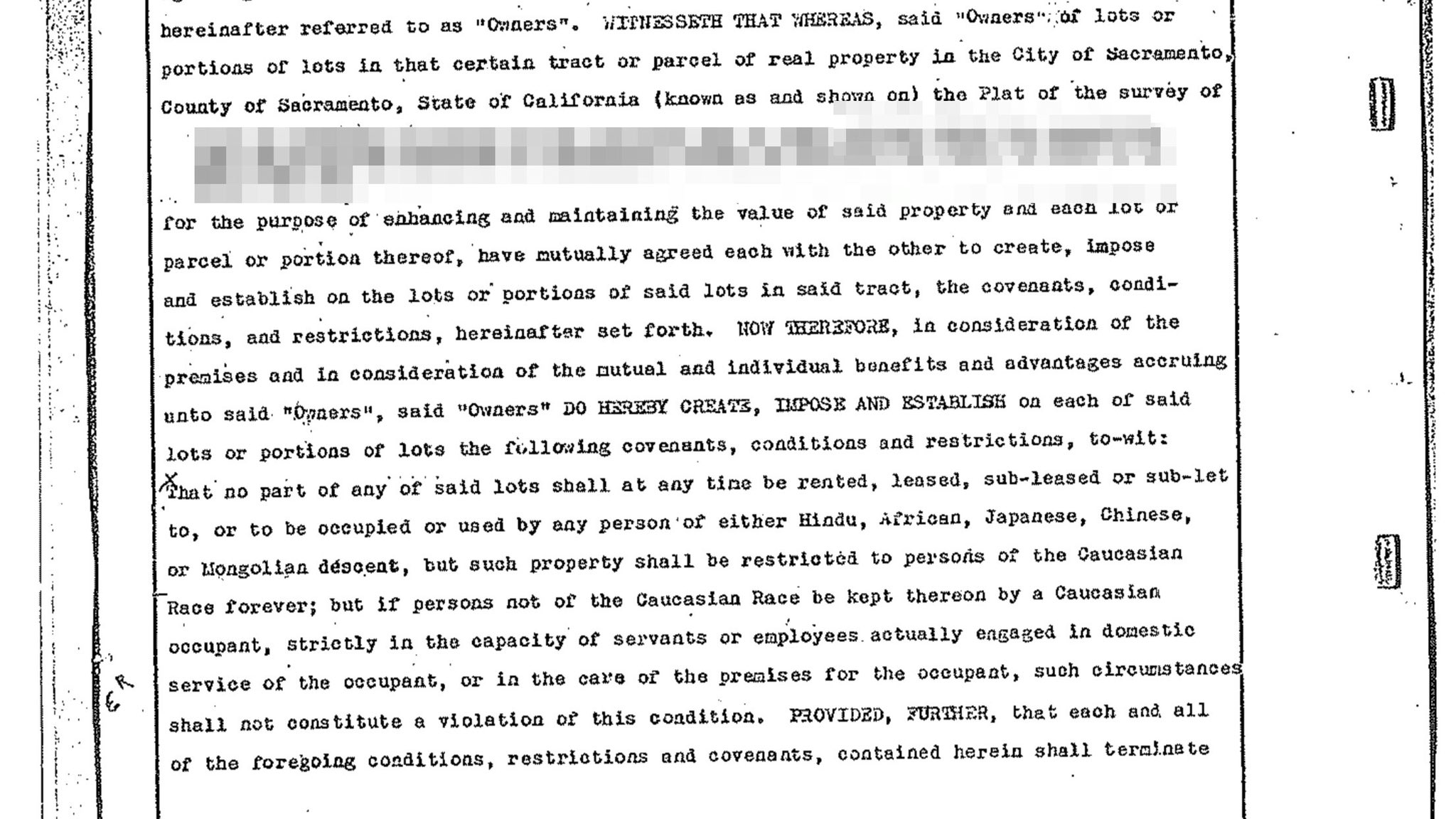
A couple years ago I was interviewed by Capital Public Radio about racially restrictive covenants. Here’s a snapshot of the CC&Rs of a property I sold that was built in 1944. “...but such property shall be restricted to persons of the Caucasian race forever.”

These CC&Rs are now legally null and void, however these records stay with the property even though they are unenforceable. Counties have an application process to remove racially restrictive covenants. Most home buyers and homeowners are unaware of this process, and I hope that this new legislation helps create awareness. Here are links to local county websites to their applications and more information:


If you are interested in the history of racially restrictive covenants, books like The Color of Law provide an overview. 

Monday, February 11, 2019

Ramifications of jointly purchasing a home with a non-spouse...

Home buyers come in all shapes and sizes. A home buyer could be a single person. Or a married couple...Or an unmarried couple. Maybe two friends. Two siblings. Parent and child. You get the idea. But let's be real. There is a lot to consider when purchasing a property, and potentially a lot more to discuss when you are purchasing a home with someone who is not your spouse.

When buying a home with a spouse, your finances are usually at least somewhat co-mingled. California is a community property state, so a home purchased likely belongs to both of you equally no matter who brings what to the table financially.

But hey, it's 2019, and not every deeply committed couple gets married. Or perhaps two BFF's decide to purchase a home to be able to afford a nicer or larger place than one could afford individually. Or parent and adult child decide to jointly buy a home so grandma can watch the kids while adult child is working. I have worked with buyers in all of these scenarios and more.

But let's talk about the ramifications of making a large joint purchase for a minute. A home is a large asset to own jointly. If you are planning to buy a home with someone, you should have a pretty candid discussion the other person about your intended mutual financial arrangements and obligations owning a home together. And, if you were to separate, you should talk about how you would divest yourselves from it.

The road to hell is paved with good intentions. Couples who are deeply committed do separate sometimes. BFFs maybe eventually get married and want to move somewhere else with their new spouse. Or grandma gets tired of constantly having the grandkids around and wants a place of her own.

It can be a tough conversation to have. Buying a home is exciting, and this conversation can be a real buzzkill. It's as exciting of a conversation to have as, for example, creating a prenuptial agreement. But it is a really necessary conversation to have so everyone has the same expectations.

You should be thinking about this stuff and get mutual clarity on:
-Who is making what percentage of the downpayment?
-Who is paying what percentage of closing costs?
-Who will make what percentage of the monthly mortgage payment, utilities, HOA dues, property taxes, insurance, etc.
-Will this be a 50-50 ownership? Or some other percentage? Perhaps you may not want a 50-50 ownership if one of you will carry more of the financial load.
-How will you hold title to the property? (Married couples usually are "Joint Tenants" where essentially both owners collectively own 100% of the real property, and in the event of the death of one owner, the surviving owner retains 100% ownership. It might make sense to explore other forms of vesting, like for example "Tenancy in Common" where each owner owns an individual interest in the property. That interest could be sold on its own. There is also no right of survivorship, such that one interest does not automatically go to the other owner upon death and could be bequeathed to a beneficiary.) You should consult a CPA or an attorney on that one.
-Who will pay for repairs or improvements to the property?
-How will you decide who gets to deduct mortgage interest, property taxes, and other house-related deductible expenses on your state and federal income taxes (if applicable)? If you are unmarried, each owner will be filing a separate tax return.
-And most unexcitingly, if you were to separate and want to sell the property, would you split the net proceeds down the middle? Or would you want to first recoup your downpayment, closing costs, repair costs, and then split it? Or if you have individual ownership interests in the property, and one wants to sell his/her interest, should the remaining owner have any input as to who the new co-owner would be?

It's not exactly fun to discuss the termination of anything (especially a relationship or friendship), but it is also best to be on the same page now. It might be worth it to even draft an agreement relating to this sort of thing...

I know, buzzkill. But if you don't feel comfortable enough to have this conversation before making your purchase, perhaps you should rethink your purchase with your potentially joint co-owner.

As an agent, I see these scenarios play out all the time. Everyone is excited and happy to make the purchase. But then when things go south, it is a tense situation and nobody is on the same page when it is time to sell the property. Things are usually a little more straight-forward when a married couple separates (usually joint tenants, usually proceeds of a sale are split down the middle, if spouses do not agree usually divorce attorneys or judge help to steer the decision-making), however when people are unmarried it can get messy quickly.

Save yourself the trouble and think about these things in advance.

Saturday, January 19, 2013

FannieMae and FreddieMac announce a few changes involving buyers and sellers of short sales...

Fannie Mae and Freddie Mac have announced the following key changes for all parties involved in a short sale. These changes apply to all Fannie Mae and Freddie Mac short sales, with an offer and without an offer. (To find out if you have a loan backed by Fannie Mae or Freddie Mac, click here. No matter which mortgage company(s) you make your payments to, your odds of having either a Fannie Mae or Freddie Mac-backed loan are pretty high.)

Title Transfer requirement change:
  • The buyer is prohibited from selling the property for any sales price for a period of 30 days from the date of the deed.
  • After a 30 day period, and until 90 days from the date of the deed, the buyer is further prohibited from selling the property for a sales price greater than 120% of the short sale price.
This applies to ANY buyer, not just an all-cash investor buyers. And the restrictions will run with the property. So investors looking to flip property -- there will be a deed restriction that pops up on your preliminary title report when you go to sell. You will not be able to get around this...so if you want to flip these properties for a profit of more than 20% you will have to wait until day 91 after the change of ownership to enter into contract to sell.

Here is their example on how to calculate the 120%:
-Purchase Price is $100,000.00
-120% of the purchase price would be $100,000.00 x 1.2 = $120,000.00

Relocation Assistance changes: The borrower/seller may be entitled to an incentive payment of $3,000 from Fannie Mae / Freddie Mac to assist with relocation expenses following successful completion of a short sale unless:
  • The borrower/seller is required to contribute funds or execute a promissory note (this would be HIGHLY unlikely in California since legislation has prohibited that practice).
  • The borrower has Permanent Change of Station (PCS) orders and receives a Dislocation Allowance (DLA) or other government relocation assistance.
  • The servicer has knowledge that the borrower is receiving relocation assistance from another source other than the servicer. If the borrower receives relocation assistance from a source other than Fannie Mae / Freddie Mac or the Servicer, the difference in the relocation assistance amount up to the $3,000 incentive maximum may be provided. If the borrower will receive relocation assistance from a source other than Fannie Mae / Freddie Mac or the Servicer and the amount is equal to or greater than $3,000, no relocation incentive will be provided.
Big fun in the ever-changing world of short sales! As an agent who lists a lot of Sacramento short sales, I keep up with all of these changes...

Monday, October 3, 2011

Ask Erin: How does an IRS Tax lien affect a short sale?

If you follow me on Twitter, you will know that today I discovered that the seller of one of my Sacramento short sale listings has IRS Tax liens from 4 separate tax years. What exactly does this have to do with my short sale, you ask?

Liens of this nature attach to real estate owned by the seller. When that property is sold, the liens are then paid in full out of the net proceeds of the sale. In short sales, where there are ZERO dollars in net proceeds from the sale -- this creates a potential problem! The liens have to be paid off in order to transfer the title of the property to the new owner, but there is a lack of money to pay the liens...so what happens?

Well, luckily, both the Internal Revenue Service (IRS) and the California Franchise Tax Board have processes to request that the liens be "partially released" so that the properties in question can be sold and the liens go unpaid. The liens still exist and stay with the seller, and could attach to other property he or she owns or comes to own at a later time, but they are released from the subject property being sold.

If you are selling a property and have unpaid state or federal income tax, it is critical that you let your Realtor know about it, even if you have not received notice that any actual lien has been filed. Liens can pop up at any time, so even if a lien doesn't officially exist today, it might be officially recorded between now and the time you get your short sale approved and try to close the escrow.

The process with the IRS can take several weeks to complete from application to approval, and subsequent close of escrow. The approval of your application is only valid for 30 days. Timing of your request is tricky, especially if you are trying to do a short sale, since you do not always know exactly when the short sale lenders will approve the transaction, nor do you necessarily know the final selling price!

To apply, you must fill out IRS Form 14135 "Application for Certificate of Discharge of Property from Federal Tax Lien." The form requires A LOT of information and supporting documentation that your Realtor and escrow officer can assist you with -- including things like a title report, a copy of the estimated HUD-1 settlement statement, a copy of the recorded tax lien itself, a property appraisal, etc.

Then, depending on the location of the property within the state, you will mail the application and supporting documentation. You can follow up via telephone at 800-829-3903. The IRS has actually prepared videos to assist sellers with this process -- view them by clicking here.

Next week I will post about the process for making the same request of the California Franchise Tax Board...

Friday, January 28, 2011

FHA 90-day Anti-Flipping Rule - the suspension has been extended!!!

Early this month I posted about the impending expiration of the 1-year suspension that was imposed on the "FHA 90-day Anti-Flipping Rule" and the potentially negative impact this would have on our local Sacramento real estate market.

Well, great news! The Federal Housing Administration has extended the suspension! It means that buyers seeking to finance a home with an FHA loan will still be able to finance a "flipped" property that has been owned by the current seller for less than 90 days. Before the initial suspension a year ago, the “Anti-Flipping”rule meant that a buyer using an FHA loan to finance the purchase can not finance a flipped home until the title to the home has been held by the current seller for 90 days or more.

As you can probably guess, a “Flipped” home is one that someone purchases with the intent to resell it within a short time period for a profit. Also, one thing that many people do not realize, is that the flipping rules for lending can also apply to transfers of title from placing the property in a living trust, adding a family member to title before listing it for sale, etc….not just investors looking to profit from flipping.

So...yay!

Monday, December 27, 2010

Short Sales: Who pays for what...

I receive several calls per week from homeowners that are looking for information regarding Sacramento short sales, and aside from wanting to know about the process itself, one most common questions I get from them pertain to if the sale will cost them anything out of pocket, if so, then how much, and generally, who pays for what fees. Having successfully closed several short sales, I will tell ya'll what I know to be true based on my experiences.

-Who pays the real estate agent commissions? In a short sale scenario, the lender(s) who agree to forgive debt and allow a short payoff of the loan(s) pay for the real estate agent (or Realtor) commissions - generally by absorbing the costs of the commissions out of the proceeds of the sale. As a side note, often times these commissions are re-negotiated by the lender(s) during the process. Note: Real estate commissions are always negotiable and NOT set by law or local custom.

-Who pays title insurance, escrow fees, and transfer tax fees? These are negotiable between buyer and seller when the offer is initially negotiated (before it is submitted to the lenders for approval). For example, perhaps the buyer and seller agree initially that the seller will pay for 100% of title insurance and escrow fees, 100% of county transfer tax, 50% the city transfer tax. The lender(s) may negotiate that the buyer pay a different split of these fees...however the portion that is paid by "the seller" is absorbed in to the overall debt forgiveness and short payoff. Occasionally you will see a lender agree to pay one of these fees, up to and not to exceed a certain amount (for example, they may agree to cover up to $750 of the escrow fee that costs $1200). Generally then, the buyer would cover the unpaid portion of that fee. So basically, again, the lender(s) will absorb many of those types of fees.

-Who pays for a home warranty? This is negotiable between buyer and seller when the offer is initially negotiated (before it is submitted to the lenders for approval). Generally though, I would prepare any buyer of a Sacramento short sale property to expect to pay for this cost, even if you ask the seller or short sale lender to cover it. In my experience, this is paid by the short sale lender in less than 20% of my approved short sales.

-Who pays for inspections or certifications? These are negotiable between buyer and seller when the offer is initially negotiated (before it is submitted to the lenders for approval). Again, most short sale lenders will not agree to cover things like pest or termite inspections, roof inspections, sewer line inspections, or any corresponding certifications. A lot will depend on the circumstances with the condition of the property, how many loans are involved, the buyers' loan program, if the property is in default, the length of time of negotiation, etc. As a safety net - buyers, do not expect that lenders will grant these requests. Generally short sale properties are sold "as-is" and sellers can not afford to make repairs anyway.

-Will the lender(s) give the buyer credits for closing costs? These are negotiable between buyer and seller when the offer is initially negotiated (before it is submitted to the lenders for approval). I have seen this vary widely from the short sale lender(s) agreeing to pay up to 6% closing costs for the buyer (including an instance of seller-funded downpayment assistance...which is no longer possible thanks to past legislation), to the short sale lender(s) rejecting those requests. Again, much will depend on the circumstances surrounding the sale of the property.

-Who pays delinquent property taxes or liens? Sellers - if you have not been paying your property taxes or county utilities, you really need to let your agent know this ASAP! I work closely with the title company on this to make sure that we know of any lien issues in advance, but because it can take several weeks or months to get approval, new liens may pop up during the lender negotiation process. When I negotiate short sales, one of my worst fears is that after the short sale is approved an unexpected lien will pop up. This has happened to me before, and for lack of a better way of describing it - this sucks! If you can let your agent know in advance that these items are unpaid, it will save lots of headaches all the way around. IF WE KNOW in advance that these liens exist, there is a great chance that the short sale lender will absorb these costs into their overall debt forgiveness and short payoff. IF WE DO NOT KNOW in advance that liens exist, once the short sale is approved - this will halt the transaction until we can find a way to pay these liens. The seller is often financially unable to pay them, the buyer does not want to pay, the agents commission has already been reduced, and the short sale lender has already taken a loss on the loan. Sellers - please save everyone a headache and communicate with your agent.

To make a bit of a sweeping generalization, the seller usually pays nothing out of pocket to close the transaction unless specifically asked to by the lender(s).

In perhaps one instance out of every six short sale transactions I close, the lender will request that the seller make a cash contribution to close the short sale. In these instances that I have negotiated, the sellers have had cash in the bank and were financially able to make that contribution...in those instances, the lowest cash contribution one of my short sale sellers has contributed was $1,000, and the highest was $5,000.

Also, you should note that in some short sale scenarios, the short sale lender will actually pay the seller "relocation assistance" to close the short sale. I have seen this in the range of $1,000 - $5,000. Not every Sacramento short sale transaction will qualify though.

Hope that answers some frequently asked short sale questions...cheers!

Wednesday, March 24, 2010

Trying to sell a house in Living Trust? MAKE SURE your house is actually included in the Living Trust. No really.

If you follow me on Twitter, you will already know that I have had the great displeasure of working through a pretty random "Title" issue on one of my listing transactions...and then the same issue to occured on another one of my buyer transactions! All within the course of a week's time!

So a little background. In both instances where I am experiencing this issue, the homeowner had passed away, leaving their heirs (or if you want to get technical, the "Successor Trustees") the responsibility to deal with the estate, including selling the home. Under normal circumstances, the Successor Trustee has full authority to list the property for sale, and sign a new Grant Deed to transfer title to a new buyer.

So regarding the first instance of this title issue...I am representing a seller - aka, the Successor Trustee of his father's Living Trust. This man's father passed away in January, and the seller is in Sacramento (he lives in Puerto Rico) dealing with his father's estate. He wanted to list the house immediately. He informed me that he had full authority per the Living Trust to sell the home. When I looked in the tax records, it appeared that the name on the title of the property was an individual, rather than the name of the Living Trust itself. OK. So I asked Placer Title Company to provide me with a property profile....sure enough, the title to the property was held in the name of the deceased father. The seller was frustrated...the house was specifically named in the Living Trust as being owned by the Living Trust, so what was the issue? Well, in order for the Living Trust to actually own the house, and for the Successor Trustee to have full authority to sell the house, a new Deed naming the Trust MUST HAVE been recorded at the county recorder's office. And that had not been done.

So regarding the second instances of this title issue...I am representing a buyer of a property whose owner had passed away. I received a copy of the preliminary title report from the title company, and it again named an individual as the property owner, rather than a Trust entity as the owner. Inspections were completed, the transaction was rolling forward nicely, and the buyer's loan documents on the way...BUT the Successor Trustee can't sell the house, because again he does not have full authority to do so, because a new Deed naming the Trust as the property owner was never recorded. UGH.

So what do we do to remedy this situation? Well, the Successor Trustee must schedule a Sacramento County court hearing, and file what is known as a Heggstad Petition so that the home does not have to go through the probate process. This process, from what I have been told, can take about two months from start to finish.

My seller client in scenario one has this Heggstad Petition process underway, and we are not listing it until he has been granted full authority. Definitely an inconvenience, as the seller wants to get back to his life in Puerto Rico...but our proactivity will be rewarded with the ease of being able to list and sell the home in a few weeks.

My buyer client in scenario two, however, is getting the short end of the stick. We are just a week from our scheduled closing, and the Heggstad Petition process is just now getting underway. He will loose his interest rate lock. He must postpone his move. UGH.

The moral of the story - if you have a Living Trust, or are planning to create one, PLEASE be sure to record a new Deed so that not only is the house named in the Living Trust, but so that the Living Trust actually owns the house! If you have an elderly parent, it probably makes sense to check to see if this has been done for their trust. You will potentially save yourself lots of time and money later.

Thursday, October 1, 2009

A lazy Escrow Officer makes for a frustrating transaction...

ARRGGHH! If you follow me on Facebook, you will know that I have been experiencing great frustration this week surrounding delays to the close of escrow. What was the problem, you ask? A completely incompetent (or lazy, apathetic...all of the above) Escrow Officer.

This Escrow Officer, who shall remain nameless along with her company, caused major frustration and unnecessary delays to the closing of the transaction. Just for the record, the escrow holder is a neutral 3rd party that handles the money in the transaction.

Loan documents were delivered by the buyer's lender the afternoon of Thursday, September 17th. The loan officer excitedly called me to tell me they had been sent to escrow. Great! I called and left a voicemail for the escrow officer that afternoon...no call back. I emailed her Friday morning...nothing. I called again on Friday afternoon and waited on hold 10 or so minutes for her. When she answered, she said she would prepare the documents and get the buyers in to sign their loan documents immediately. She also said she would send me the FHA Amendatory Clause document, which required my signature as the buyer's agent.

Immediately turned out to be Tuesday, the 22nd and Wednesday, the 23rd. My buyer clients were an engaged couple - one is here in Sacramento, and the other is relocating here from Daly City. They were in two different places, but no effort was made to get their signings accommodated...out-of-town document signings are common, and a mobile notary or another office of the same escrow company is used.

The loan documents were not couriered back to the lender until Thursday, the 24th, and not received by the lender until late on Friday, the 25th. By this point, the escrow officer still had not sent over the FHA document requiring my signature as the buyer's agent.

On Tuesday morning, the 29th, the lender issued its funding conditions. Among the funding conditions was a signed copy of the FHA Amendatory Clause. Tuesday morning I was at the Regional MLS meeting when I got a frantic email from the buyer's loan officer around 9:30am. She emailed me the Amendatory Clause because it was required to fund the loan. I raced back to my office, signed it, and emailed to back. Around 11am, I received an email from the escrow officer with a copy of the Amendatory Clause document...kinda late, doncha think?

The lender was able to fund the loan, and the funds were received by escrow at 2:25pm that afternoon. Great! The last time to be able to record the buyer's Deed of Trust with Sacramento County is 3pm! At 4pm, I received a call from this escrow officer stating they missed the recording deadline. No recording Tuesday, and I could not give my anxious buyer clients their keys to their new Natomas home. UGH.

I was promised that the recording would happen first thing on Wednesday morning. I should have received a call from the escrow officer around 9:30am to give me confirmation that the transaction was on record. Nada...finally around 11am I emailed her. I got an out-of-office auto-reply email that she was on vacation for the next week!! WHAT!? I called the office and spoke to her assistant. ARE WE ON RECORD???

Nope! This escrow officer had "forgotten" to request a payoff demand for the HOA transfer fees. They could not record without it. ARRGGHH!!! The escrow officer should have done this weeks prior! Several angry phone calls between myself, the buyer's loan officer, and the listing agent finally resolved this issue.

We finally recorded on Wednesday the 30th...about a week after we should have. WHAT A JOKE! Good thing my clients interest rate lock did not expire! Good thing this transaction madness was not happening at the end of November, when the first time buyer credit deadline could have lapsed! Good thing this was not a short sale close to expiration! Good thing my clients did not have to be out of their apartment!

I have a great relationship with my go-to escrow officer. I know this madness NEVER would happen with her.

Friday, January 30, 2009

(No) Fun with Liens...

Liens are a headache. This entire week, I went back and forth with a short sale lender regarding liens that were recorded on one of my short sale listings between the time the package was submitted to the lender, and the time the short sale was finally approved.

What type of liens, you ask? Two unpaid utility liens and a Sacramento County property tax lien, totalling about $4,000. Before title can be transferred and title insurance issued, the liens must be paid in full.

Luckily, after several 3-way calls with the title company and lender, lots of faxed documentation, and a couple hours of listening to hold music, I was able to convince the short sale lender to absorb the cost of the liens into the short sale. Phew!...luckily this did not take too long to resolve and it is not going to delay the close of escrow.

Wednesday, January 7, 2009

Ask Erin: What happens to unpaid utility bills on bank owned REO properties in Sacramento?

With so many REO properties on the market for sale in the greater Sacramento area, I feel it is my moral obligation to warn buyers about the ramifications and potential consequences of previously unpaid utility bills.

When a property owner goes into default, along with not making the monthly mortgage payment, many owners stop paying their property taxes, and they also stop paying their utilities - like their water, gas, and electric bills.

When property taxes go unpaid, the county that collects the property taxes will record a lien against the property. When a title company later does a title search to see if there are any liens or other encumbrances, property tax liens pop up and are detailed on the preliminary title report. Easy. It's out there for all to see. Title to the new owner will not be transferred until these liens are paid - usually cleared by the selling entity / bank.

When utilities go unpaid, sometimes liens are recorded. More often, unfortunately, liens are not recorded. This means that unpaid balanaces to the local water district, power company, or gas provider will not show up as liens on the preliminary title report.

What does this mean to a buyer of a foreclosure property?

It means that if you do not take the time to investigate the status of the utility billing to determine if there is a past due amount, and there is a balance due by a previous owner (or even the previous bank owner) - once you take ownership of your new house the utility company may refuse you service until the amount is PAID IN FULL, or they may attempt to collect the entire past due amount FROM YOU.

Buyers - be SURE to investigate this during your escrow. Call the local water district, call the local power company, call the local gas company. Make sure that the bank owner is current on these bills. You will have to call these utility companies anyway to set up your service. If there is a past due balance, be sure to submit documentation to the bank seller prior to the end of the transaction - this way you can be sure the bank seller pays these bills current. Be sure to have your agent ask to see the seller's settlement statement prior to the close of escrow so that paying off these invoices does not get overlooked. After the close of escrow, if a utility company denies you service or bills YOU for this unpaid debt, it is likely you will have no real recourse with the former seller.

Ever stop to wonder what a water bill amounts to if unpaid for 11 months? What about SMUD or PG&E. It can be in the hundreds of dollars. Unfortunately logic does not rule here. Logically speaking, a buyer should be able to provide documentation as to when the transfer of ownership occured, and that should satisfy the utility company to turn service on, or try to collect the unpaid amount from someone else. This is not the case. These companies want to collect - and will do so at your expense. Several agents in my office have learned this lesson the hard way - don't let it happen to you...

Monday, December 1, 2008

LandAmerica files for Bankruptcy Protection...

According to a press release on LandAmerica's own website dated 11/26/08, the title insurance company and a subsidiary company have filed for bankruptcy protection. Surprisingly (perhaps just the sake of timing around the holiday?), I have not heard about this at all in the media.

This I just don't get? It seems that for the majority of my REO transactions, these guys seem to be the preferred title insurer.

Wednesday, October 22, 2008

SB 133 - Has Regulating the Marketing of Title Insurance gone too far?

Though officially, SB 133 does not take effect until January 1, 2009, locally title companies are implementing its new standards now. Title company "Business Development" (sales) representatives will have to be licensed with the department of insurance. While there have been pre-existing rules in effect regarding "inducements" (kickbacks, gifts, etc. in exchance for doing business), this bill takes everything to a new level.

While I definitely agree with the concept of the legislation, the practice and everyday implications of this legislation seem never-ending and, quite frankly - pretty scary.

Now title reps can not participate in any Sacramento Association of Realtors committees (example - the title rep that serves on the Young Professionals Council must resign her position at the end of the year). Title companies can not sponsor any SAR or real estate office events or fundraisers (example - sponsor a booth at an annual conference). A title rep can not bring food or drink to a SAR or real estate office meeting or party (example - can not provide a pot of coffee at a regional meeting). If a title rep and a real estate agent happen to be friends, the title rep can not buy the agent a birthday present...can not validate parking...can not make copies at an escrow signing...how far does this really go?

If a title rep is caught violating any rules, they can be subject to personal fines, and have their license revoked (they can not reapply for 5 years).